


Anthroposophy in Hawkes Bay
Rudolf Steiner Centre, 401 Whitehead Road, Hastings
Events over next 2 weeks
[7 to 21 December]
[In order to reduce the volume of the Newsletter, Notices and Posters for events will be put in once only. After that, references in these short notices will be by Links to the original notices in previous Newsletters]
- TONIGHT Sunday 7 December.
A performance of the Oberufer Paradise Play at Rangimarie** - Friday 12 December. 7 pm. Friday Study Group. Karmic Relationships - esoteric studies. Vol VIII (Books are available)
- Saturday 20 and Sunday 21 December. Summer Festival.
~~~~~
future 2025...
- Wednesday 24 December. 8 pm. Christmas Celebration
~~~~~~~~~~~~~~~~~~~~~~~~~~~~~~~~~~
2026
- Weekend 10-12 January. Social Eurythmy with Teresa Mazzei at Michael Park School, Ellerslie**.
- Weekend 17-18 January. 'Deepening Course' at Titirangi RS School**
- Saturday 21 February. 2:30 pm. SGM to consider Change of Rules/Constitution.
- Saturday 28 February: Humour and Rudolf Steiner the Cartoonist with Van James from Hawaii.
- Friday 6 to Sunday 8 March. NEW GROUND Youth Festival, Tauranga.
REMEMBERING ROBERT SIMPSON
Robert died this week in the wee hours of Tuesday morning, after sudden admission to hospital, but still able to be accompanied by a circle of close family and friends as he peacefully crossed the threshold. His funeral, or better, the celebration of his life, was held in the Te Awanga Hall on a glorious Friday. A big crowd of friends, family, Hohepa colleagues and residents, enjoyed musical and verbal tributes. We heard his story and life’s journey starting as the youngest son of an apple orcharding family in the Tasman district, leaving home for Canterbury University, becoming a rather hippie, hairy, very fit youth, followed by several years spent living an alternative lifestyle on the West Coast of the South Island. Eventually Robert found his way to Hawkes Bay to further his jewellery making at the old stables above EIT, which were then the Art Department of the Community College. During that time Robert met Rosie and was introduced to Hohepa, where Rosie was a class teacher. He was immediately embraced by the children there who loved it when he came on Sunday afternoon walks. They had been together only nine months when Robert was diagnosed with a brain tumour which was followed by the discovery of another in his lung. He survived surgery for both, but the prognosis was somewhat bleak. This was a significant turning point in Robert's life, and he devotedly took on his healing through anthroposophical medicine and therapies along with the study of anthroposophy. His recovery from this trauma was remarkable and soon Peggy Harris, with her characteristic prescience, decided that Robert should be a class teacher at the Home School. Very much in the spirit of trust and confidence that it is who the person is that makes the teacher, not the training they have had. Thus began his long journey with, and dedication to, the Being and children of Hohepa. In sensing what was needed by the children he had taught and with the musical gifts he had Robert found his destiny pathway to becoming a music therapist.
The prayer below was given to Robert by either Dr Ken Friedlander or Peggy, who was Matron of the Hohepa school when Robert received his diagnosis. Rosie writes: “Interestingly, Robert was not an anthroposophist or would have called himself a Christian at that time but I remember him going to a quiet space on the hill behind our little cottage in Main Street and learning it before we went up to Auckland for his surgery and where he spent months in hospital. It became a very powerful and protective mantra for him. And has been all his life. He would be very happy for you to mention it or include it in the newsletter. Over the course of his life, he gave it to so many people who he thought would be helped by it.”
That surgery was over 40 years ago!
This version of the prayer in illness is the one Robert used. It is a translation by Ken Friedlander who saw that an important line was missing from the version you will find published in Verses and Meditations.
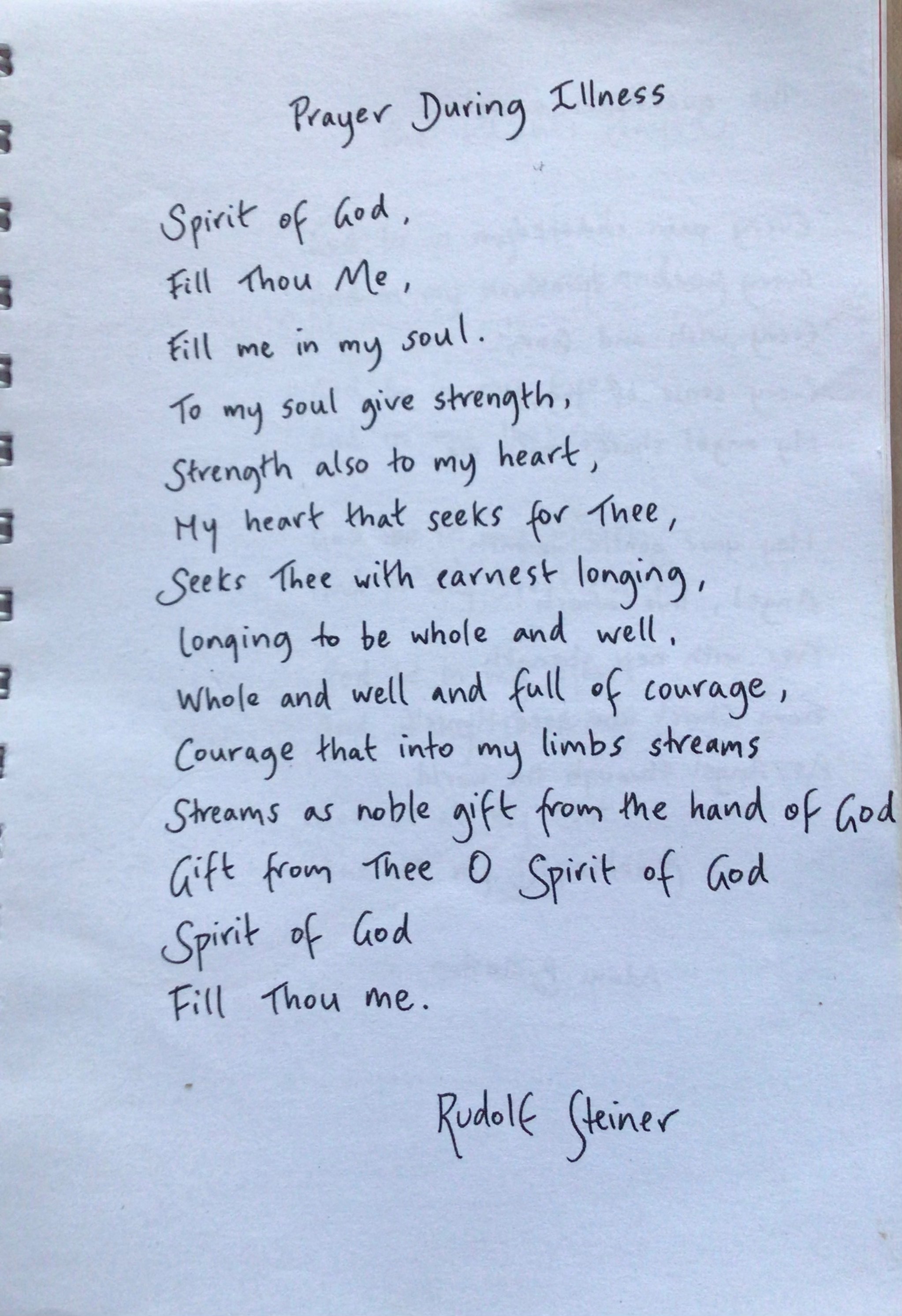
Norbert Mulholland will be in Hawkes Bay for the week 15th to 22nd December.
He is giving a talk on the 20th for our Summer Festival, and partaking in the Spirit of the Word School, where he will be working with our students in that week.
Anyone who would be interested in joining the morning chorus and perhaps some poetry/drama sessions is welcome to join for a small contribution of $15 per session or $60 for the week. Please let us know by next Saturday, 13th.
Accommodation needed: If anyone has a spare room where Norbert could stay for the time, please let us know. It would helpful if we could support him in this.
Helen Proctor will be working with us at the Summer Festival on a special sequence in musical eurythmy, an interval progression that helps to connect to our higher self at this summer time. This fulfillment can be found leading up to the octave and returning to the tonic. Rudolf Steiner gave the indication for this interval sequence which can be found in his book: ‘The Initiate Consciousness’.
Helen grew up at Hohepa, where her parents were dedicated house-parents and active co-workers in many areas of Hohepa life. Helen, a local Steiner School student [a member of the first full Class 12 (Ed)], studied medicine at Otago University and the University of Witten Herdecke and music at the Schola musica in Wellington. In Germany, she found her special undestanding and skills for her present medical work. Having done an anthroposophical nursing training and anthroposophical medical training in Germany, she then started a medical practice in Hamburg before returning to NZ 8 years ago.
Helen is a trained anthroposophical doctor, homeopath, trained in muscular skeletal therapy and the Art of Curative Eurythmy.
We are very fortunate to have the benefit of the new skills from anthroposophy for a future consciousness, also in medicine and the art of healing.
Astrid Anderson and John Jackson.
021-215 4019 022-122 8002
"We are not human beings having a spiritual experience.
We are spiritual beings having a human experience."
French philosopher and priest Pierre Teilhard de Chardin has received credit for this remark,
~~~~~~~~~~~~~~~~~~~~~~~~~~~~~~~~~~
MARGARET JACKSON - Obituary
It is with sadness that we share the passing of our mother, Margaret Alice Janette Jackson born 10 September, 1930; died 4th December, 2025 [95y]
We would like to share a brief account of her life story.
Margaret was born into a family of 7 children; she was raised on Moorgate Farm attached to the Blickling estate in Norfolk.
She started work at 14 years old at Sunfield Children’s Home in Clent, Worcestershire, where she helped look after children in need of special care. It was here she was introduced to anthroposophy.
She was inspired to train as a nurse and completed her training at Queen Mary’s Hospital for Children in 1954 – a 3-year course.
In late 1957 she was called to move to New Zealand and be the first registered children’s nurse for the new Hohepa Homeschool kindergarten.
There, she met Michael Jackson and they had a Hohepa staff wedding at the home school in late 1959.
The 1960’s were devoted to family life in Havelock North.
In 1970 she returned to Hohepa and took on a dormitory parent role for 5 young boys for half a year.
I think it was at this time that she produced the first performance of the Shepherd’s Play in the school.
She then lived on a farm at Te Pohue helping Michael bring the farm back to full health.
The family then moved in 1979 up to Waimate North, near Kaikohe, because of the link with Henry Williams (on the Jackson side of the family).
She returned to Norfolk, UK, in 1996, where she spent time with her grandchildren, Maria, Spencer, Caroline and Markus.
She returned to New Zealand in 2008 to be with her family in Woodville.
She spent her last 4 years at Iona Home and Hospital in Oamaru.
Joy, Nick and John Jackson
~~~~~~~~~~~~~~~~~~~~~~~~~~~~~~~~~~
Seeking Truth
continued
'It has always been the goal of the thinker to attain to Truth untainted by any personal colouring, to Truth as it exists above, and untouched by, any personal likes or dislikes, any prejudices or opinions. This was ever the ideal of the true scientist, the true philosopher: to let pure truth live within him or her. It was clear to such thinkers that true concepts are not specific to any individual. The same truth can live in one mind or in many.
Yet even when the human being has acquired the certainty that all true thoughts are universal, and that even his thinking activity itself is a universal activity projecting into him from world existence, he still brings this thinking activity unfolding within him into the service of his own self. As a being endowed with self-consciousness, a being centred in his own ego, he does not know how to place this thinking activity at the service of another being or beings.
How does one think not for oneself but for others? Even the idea of what this might be is not immediately apparent. Suppose I see someone struggling with a mathematical calculation and I offer to do the calculation for him. If I do so, I have carried out my thinking activity for his sake. The motivation may be altruistic, to some degree at least, but the thinking activity itself is no different from usual. I still have the same relationship to my thinking activity notwithstanding the fact that I have destined its fruits for another person. Even if I were to think aloud, expressing in words each step of my calculating so that the other person could follow the process, my basic relationship to my thinking activity would remain unchanged. No particular training of the consciousness is required for it. What Rudolf Steiner meant when he spoke to the young people was something quite different, as we shall see shortly.
Rudolf Steiner's statement that there is only one single concept of 'triangle', and that it is quite immaterial for the content of this concept whether it is grasped in A's consciousness or in B 's, may seem quite obvious to us once we have read his words. And we may easily grasp the principle that the one uniform concept of 'triangle' does not become a multiplicity because it is thought by many persons. Because the thinking of the many is itself a unity. Yet there lives in universal thinking a concept, the universality of which we do not so readily recognize. It is the concept of our “I”.
Even though we may recognize in principle the fact that the “I” - consciousness of every human being is an individual consciousness of the same universal “I” – in other words, that the "I" of which I am conscious is the same as the "I" of which you are conscious -- yet something holds us back from giving up our personal experience of the "I" in favour of a larger, shared experience of it. We feel instinctively that we would be losing our own identity, even though logical thought tells us that this cannot be the case. But what is this force in us that instinctively rejects any sharing of the "I"-experience, that wants to exclude from our own consciousness the "I"-consciousness of any other being, and isolates us within our personal "I"-experience? It is the force of egoism, of antipathy, to which we owe the acquisition of our individuality and our freedom.
Now, it is quite clear that we are not intended to lose our individuality and our freedom; the whole point of Earth's evolution up to the time of the Mystery of Golgotha was to enable us to acquire them. And we know that without the force of antipathy in us we could never have done so. But what if we now wish to follow Christ? Then the question confronts us: if we replace antipathy with sympathy and venture beyond the narrow confines of the self towards a wider, more universal experience of the "I", will we lose our individuality and our freedom? Will we lose them? Is this not the existential question today? Even when the Christian in us contemplates the great Pauline ideal, "Not I but Christ in me", is there not a voice that whispers deep down inside us: "No, no, I don't want to give up my own "I", not even for Christ. I want to be myself!" This voice is there in all of us, whether we are conscious of it or not. It is the voice of a very powerful instinct. It is our egoism, the antipathy in us.'
Would we lose our individuality and our freedom? No, we would not. Let us go back for a moment to what we said in the previous chapter concerning the arising of the "I"-consciousness in the human bodily organization. We quoted from the following passage in The Philosophy of Spiritual Activity:
"Now, what takes place in this organization when we think has certainly nothing to do with the essential being of thought, but it does have to do with the formation of the "I"-consciousness through thought. The true "I" lies within the essential being of thought, but the "I"-consciousness does not. This is clear to anyone who observes thought in an unprejudiced way. The "I" is to be found within thought; the "I"-consciousness arises through the fact that in ordinary consciousness the tracks made by the thinking activity engrave themselves into the organization. (Thus the "I"-consciousness arises through the bodily organization. But this should not be mistaken for an assertion that the "I"-consciousness, once it has arisen, remains dependent on the bodily organization. Once the "l"-consciousness has come into being it is taken up into thinking and shares henceforth the spiritual being of thinking.)"
We needed antipathy, the force that separated our bodily organization and our soul-nature from the physical and soul worlds, in order that our "I"-consciousness could arise by their means.
How does it arise? It arises through thought. One might say that the universal "I" thinks itself within the human being and calls forth a reflection of itself in the organization of body and soul. Once this individual "l"-consciousness has come into being it becomes independent of that organization. It is taken up into universal thought and becomes thereby a spiritual reality. This is, henceforth, our spiritual identity, our "I". Our freedom as an individual is grounded in the "I", not in the "self'. It is the. “I”that takes into itself the universal force of thinking and partakes thereby of the all-encompassing being that pervades everything. Eternal truths live within the "I", which edifies from them its highest ideals. This is the basis of human freedom. When man allows himself to be ruled by that which comes from his nature of body and soul, by his urges and passions, he is a slave to this lower nature, even though he may believe he is following his own free will. An action is truly free in so far as the reasons for it spring from the ideal part of one's individual being. The human being is free to the extent that he is able, in every moment of his life, to follow himself, that is to say: to follow his “I”.
Since our "I", once it has arisen, becomes independent of the earthly "self' and partakes of the existence of universal thought, it shares its essence with that of the "I" of every other human being. It receives an individual stamp in each separate human being only because it is related to his individual feelings and sensations, which depend on the organization of body and soul. What distinguishes us from one another above all, and makes individuals of us, is this organization of body and soul – the "sheaths" of the "I". Egoism and antipathy are proper to the three sheaths: the physical body, etheric body and soul, but not to the "I" itself:
"The human "I" is enfolded in three sheaths. The "I" itself is not egoistic; only the sheaths are egoistic. Were the "I" to be liberated from its sheaths, it would immediately seek to expand into the whole cosmos. But it is enclosed within its three sheaths."
These sheaths naturally continue to be the earthly envelope of the "I" even if the latter expands its sphere of experience. Since it is the sheaths that give us our individuality, this is not in any way diminished by an expansion of the "I"-experience. As for the essence of the "I" itself, it is already shared with the "I" of every other human being. These considerations are of importance because they help to shed light on the new direction given to human evolution by the Mystery of Golgotha.
(to be continued)
(Emberson, Paul [2014], “From Gondishapur to Silicon Valley” p929 to 931)
Posted: 6 Dec 2025