


Anthroposophy in Hawkes Bay
† † † † † † †
Kristina Monica Magdalena Friedlander
23 July 1955 to 10 January 2026
Kristina passed away peacefully on Saturday, 10 January 2026, at her home in Hastings
Beloved mother, partner, sister and friend, a warm and generous presence. Kristina was a dedicated and wonderful nurse and healer. Her wise and kind heart will be remembered with gratitude by many.
Kristina is at home at 906 Queen Street, East, Hastings. Friends are welcome to visit on Sunday, 11 January 2026 and Monday, 12 January 2026, between 11 am and 4 pm.
A private family service will be held for Kristina.
† † † † † † †
Rudolf Steiner Centre, 401 Whitehead Road, Hastings
Events in brief
over next 2 weeks
11 to 25 January 2026]
All is quiet and summery with a scorcher predicted for today.
- Monday 19 January. Centre reopens.
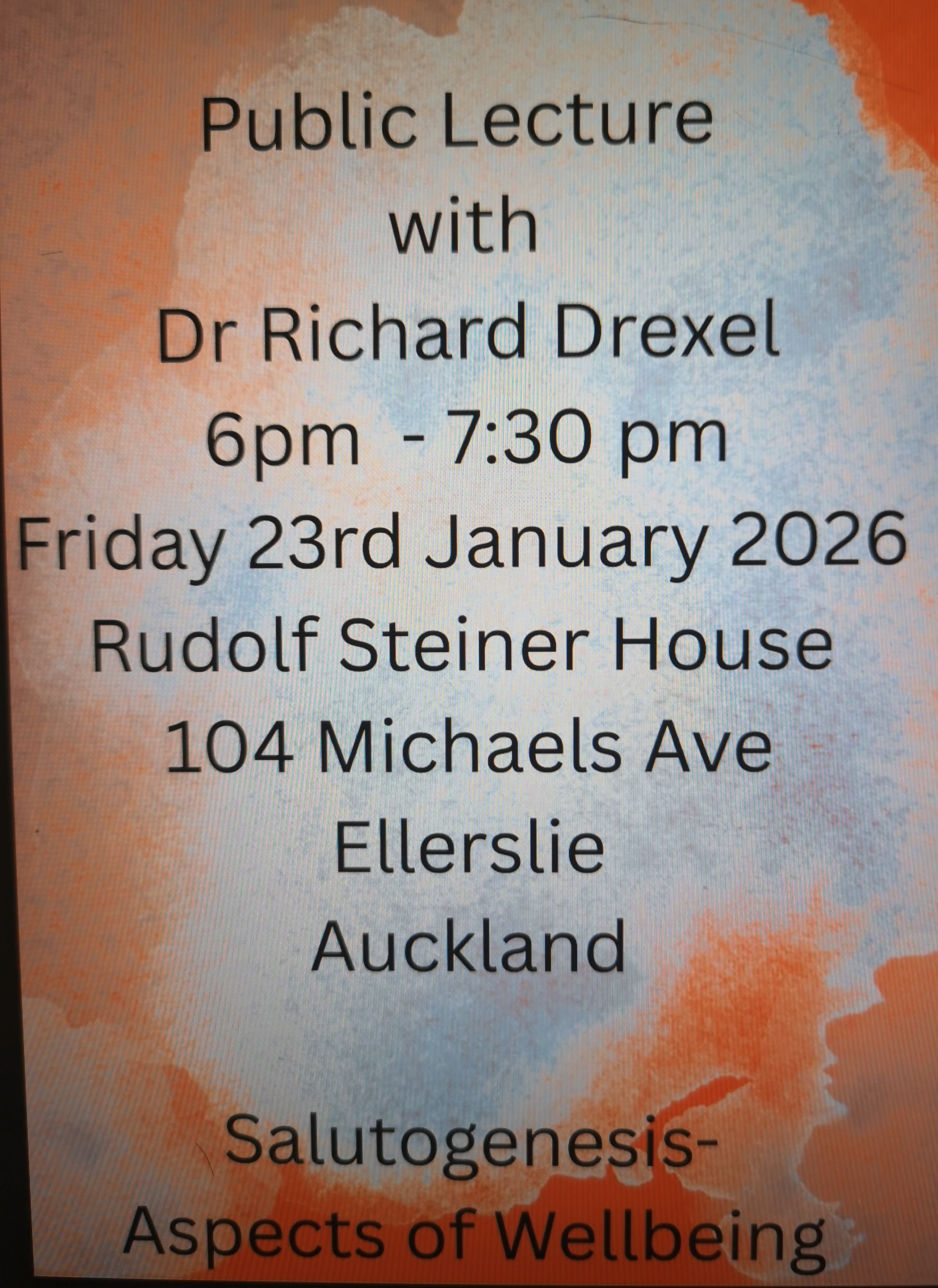
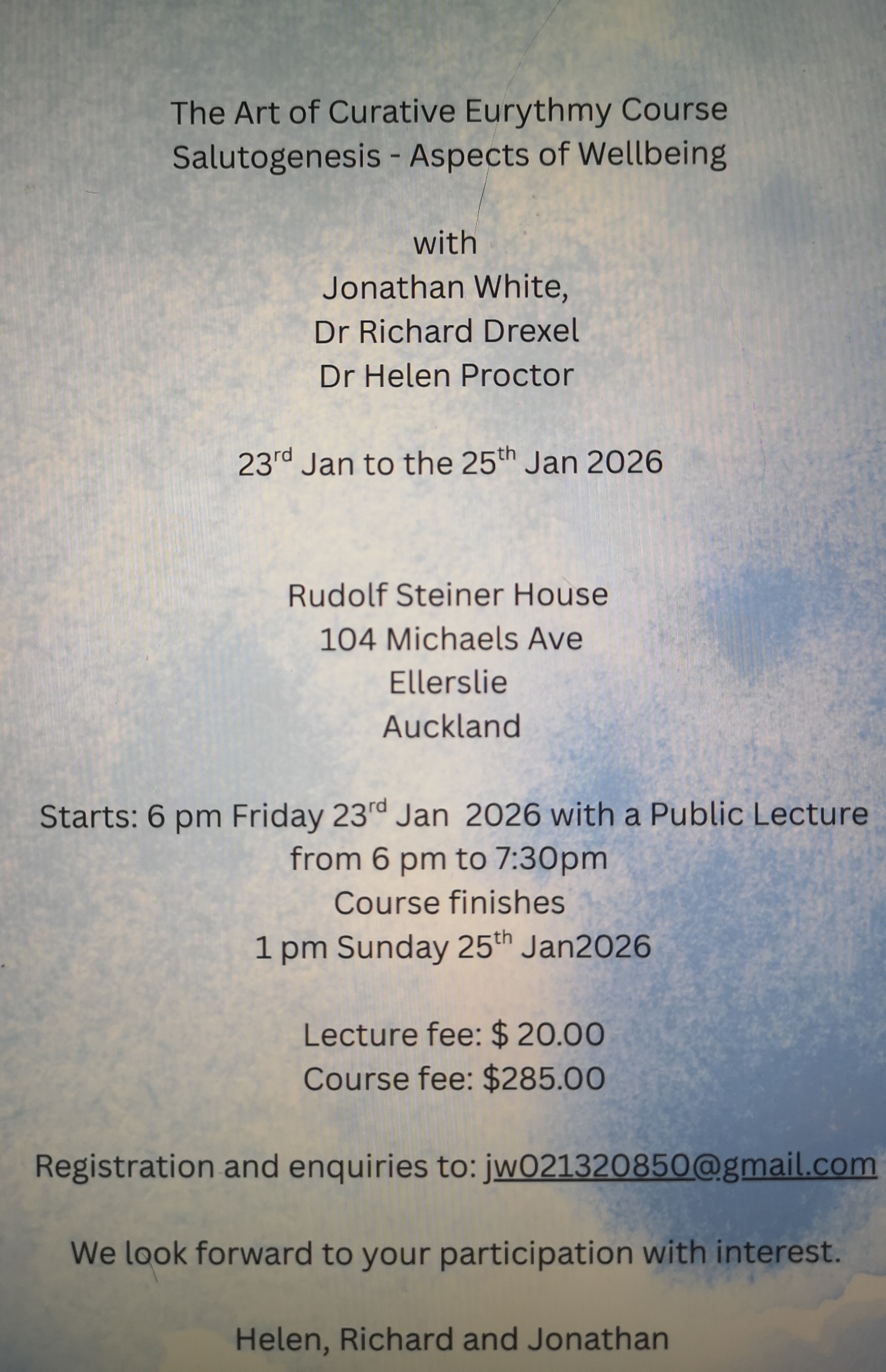
- Friday 23 to Sunday 25. Art of Curative Eurythmy Course: "Salutogensis - Aspects of Wellbeing" in Rudolf Steiner House, Ellerslie, Auckland. ** see poster
~~~~~~~~~~~~~~~~~~~~~~~~~~~~~~~~~~~~~~~~~~~~
- Friday, 30 January. Christian Maclean - will give a talk at Rangimarie entitled: “Epiphany: the Adoration of the Magi and the Baptism in the Jordan” **
- The Wednesday group meeting at the Centre will commence in the New Year on Wed 4th Feb 2026. We will continue with reading "The Spiritual Origins of Eastern Europe and the future Mysteries of the Holy Grail"
- Friday 14 February. 7 pm. Friday Study Group resumes studying Karmic Relationships VIII
- Friday 20, Saturday 21 February. A celebration "Earth Radiating Spirit" **
- Saturday 28 February: Humour and Rudolf Steiner the Cartoonist with Van James from Hawaii.
- Saturday 14 March. 2:30 pm. SGM to consider Change of HBBranch Rules/Constitution. We are required by the Charities Commission to review these every 3 years to ensure that they are "fit for purpose".
**A visitor from Scotland - Christian Maclean - will give a talk at Rangimarie on Friday, 30 January, entitled:
“Epiphany: the Adoration of the Magi and the Baptism in the Jordan”
Christian has been an Editor for Floris Books for many, many years (and still is!) and for some recent years is a member of the Christian Community Foundation - a group that supports The Christian Community founded in 1922 as a free church, in the area of the donation of the sacraments, teaching, pastoral care and the training and ordination of men and women as priests and of their sending in Europe and overseas.
~~~~~~~~~~~~~~~~~~~~~~~~~~~~~~~~~~~~~~~~~~~~
Goetheanum's Foundation Stone
As the double pentagonal dodecahedron, the heart of the Foundation Stone laid under the first Goetheanum and still under the second, is a geometrical form I am offering some musings on GEOMETRY in the intervening weeks, as background. RB
Musings on Geometry 2
Let us keep things simple by considering closed, linear, geometrical shapes or forms drawn by straight lines going from point to point and arriving back at the starting point after a number of steps. We can move around a form, say in a clockwise direction. If we start at a point the activity alternates from moving along a line, then turning/rotating at a point, repeating. Distance > angle > distance > angle and so on. A line or lateral, edge or side joins two points or vertices. A joint, knee [-gon {genu}] or ankle [-angle] links two lines at each vertex.
I am emphasing the polarity between line [lateral, finite] and point [vertex, infinitesimal].

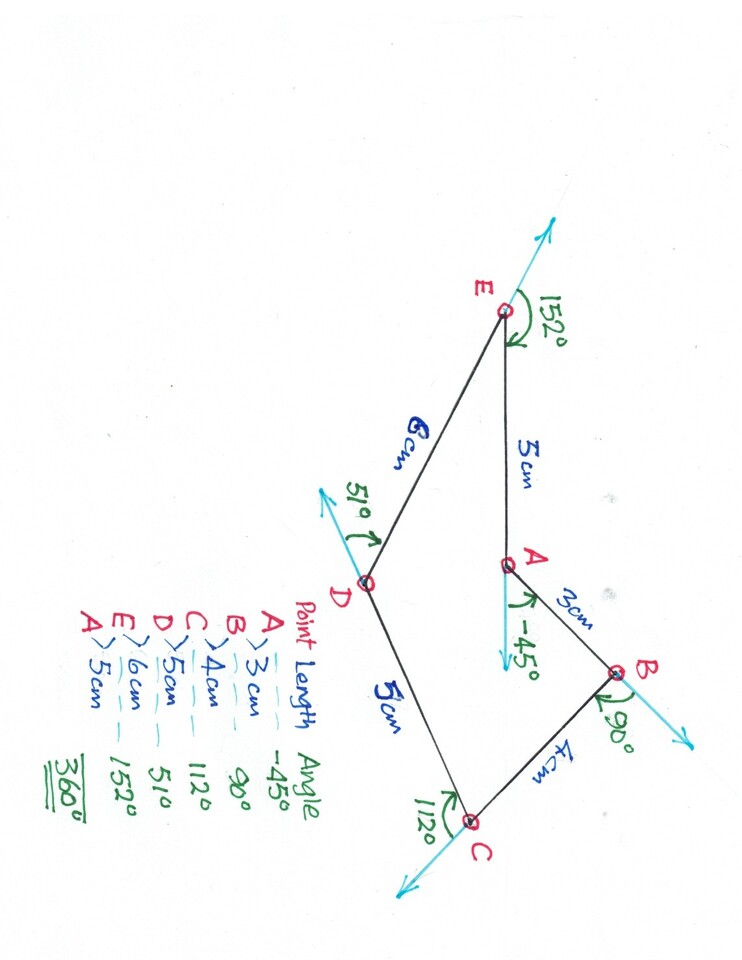
To describe a form, we could count the number of steps, the length of each line between points and the angle of rotation between the lines at each point. In the following diagram of a random, irregular pentagon, a clockwise rotation is measured as positive (+), anticlockwise as negative (-). A complete turn is 360º.
The names of these figures are derived from Greek and Latin (see chart of words with numbers in them) so we start with 3 – triangle, 4 – quadrangle, quadrilateral or square, 5 – pentagon, 6 – hexagon, and so on.
Let us look at one of the simplest forms: TRIANGLES.
If we look at triangles, we can categorise them according to the degree of symmetry they show:
- All 3 sides/angles equal – Regular = Equilateral + Equiangular,;
- 2 sides equal – Isosceles [same legs];
- No sides equal – Scalene.
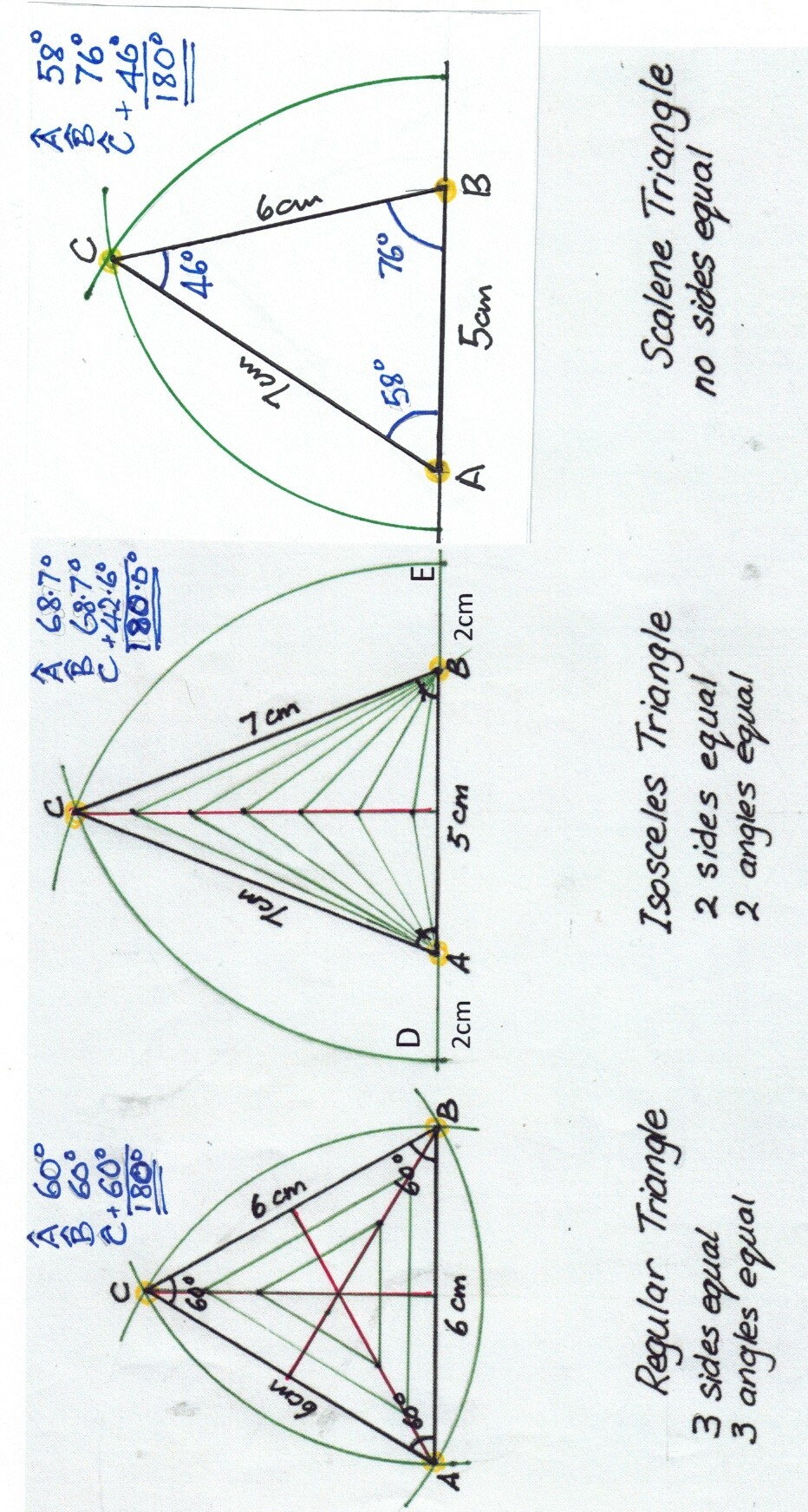
- The Regular Triangle has THREE lines of symmetry;
- The Isosceles Triangle has ONE line of symmetry;
- The Scalene Triangle has NONE.
You will also notice that:
- the longest side is opposite the largest angle
- the shortest side is opposite the smallest angle
Triangles can also be categorised by the size of their largest angle:
- Angle < 90 – acute (sharp)
- Angle = 90 – right
- Angle > 90 – obtuse (thick)
This distinction is very important in the famous Pythagoras Theorem, which we will look at later.
The Regular Triangle [tripoint, trilateral, triline, ...] is of special interest because it is unique in its shape, as it is both equiangular and equilateral.
Here are the first six Regular Polygons: Triangle [3 sides] to Octagon [8 sides]
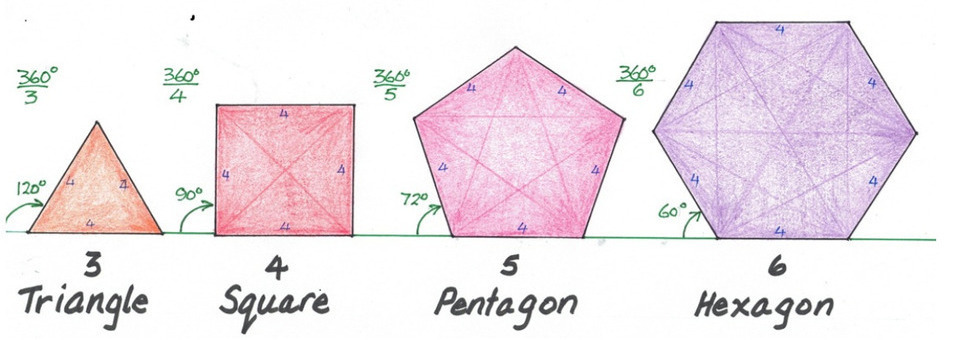
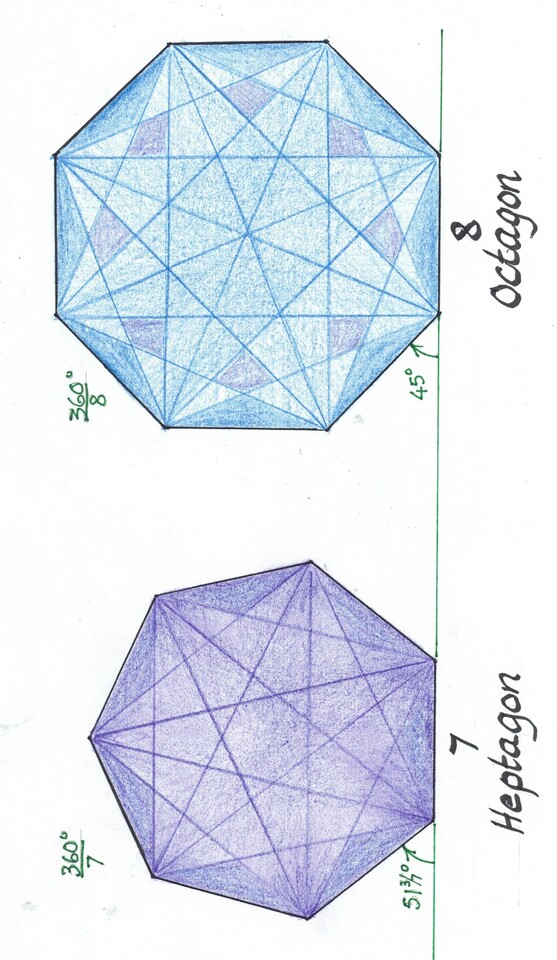 When we nest them all together they look like this:
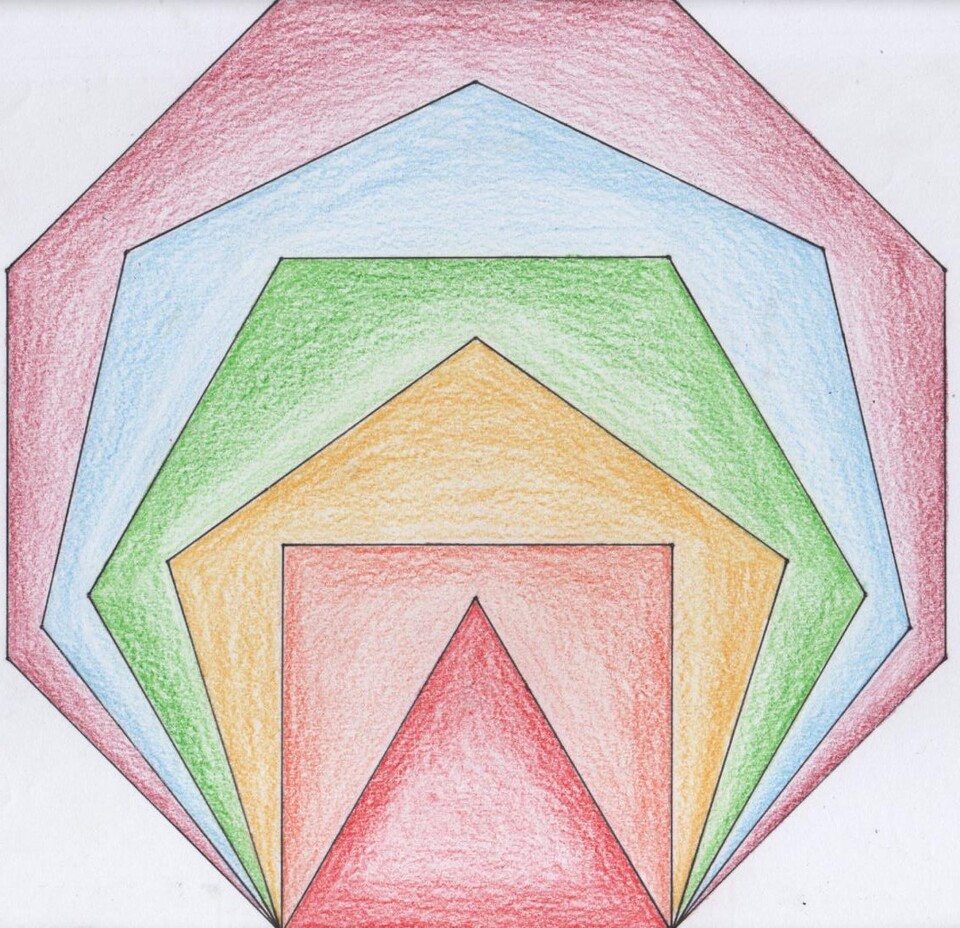
Odds and Evens - what do you notice?
Next week we will look at the various Centres of a Triangle and the Symmetry of Quadrilaterals.
RB
Posted: 8 Jan 2026