

Anthroposophy in Hawkes Bay
Rudolf Steiner Centre, 401 Whitehead Road, Hastings
Events in brief for your diary
over next 2 weeks: 31 May to 14 June 2026
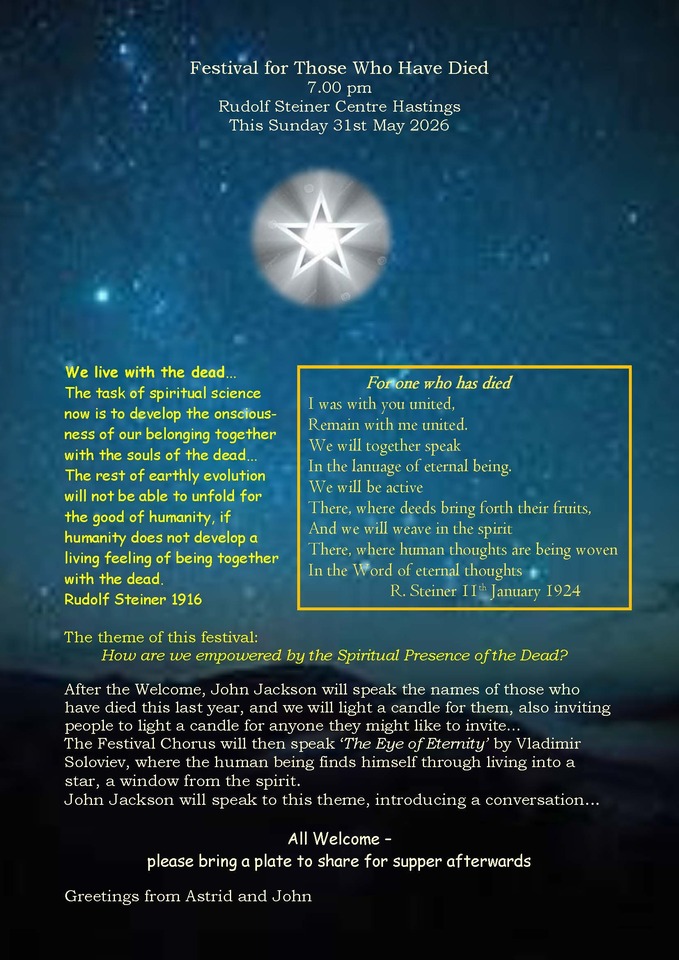
- Sunday 31 May. Evening to Commemorate the Dead.
- Friday 5 June. 5 to 6 pm. NZAS Council Consultation meeting with members re proposed changes to NZAS Constitution.
- Sunday 7 June at 7pm David Urieli will give a talk in the Centre on life after death – That is what insights that anthroposophical spiritual science can offer on life after death.
- Friday 12 June. Talk by Dr. Richard Drexel on "Sleep" at Taruna College.
- Saturday 13 June. ASNZ AGM and Society Day in Hawke's Bay.
~~~~~~~~~~~~~~~~~~~~~~~~~~~~~~~~~~~~~~~~~~~~
Later in the year:
- Sunday 28 June, Midwinter Festival.
- Saturday 25 July. Anthroposophy Hawke's Bay AGM.
~~~~~~~~~~~~~~~~~~~~~~~~~
~~~~~~~~~~~~~~~~~~~~~~~~
CONSULTATION MEETING
Dear Hawkes Bay Members of the ASNZ
We look forward to meeting with you on June 5th from 5-6 p.m. at the Centre in Hastings. We have a presentation of the changes we are proposing for the ASNZ constitution, and are seeking your response and discussion points on this, before the proposed acceptance of this new constitution at the Saturday, June 13th AGM of the ASNZ.
Please take the time to come and take part.
See you then. June 5th from 5-6 p.m.
Michelle Vette and Nic Parkes
Ngā Mihi // Kind regards
~~~~~~~~~~~~~~~~~~~~~~~~~
Perceptions and Potential
Saturday, 13th June, 2026
9:00 a.m. to 2 p.m.
Anthroposophical Centre, 401 Whitehead Road, Hastings.
------------------------------
Members and friends are warmly welcome to participate on this day. The theme of the morning is Perceptions and Potential, which leads on to the
AGM of the Anthroposophical Society in NZ.
As an introduction to the theme, Jane Bradshaw, General Secretary of the Australian Anthroposophical Society will speak to us from her home in Australia via a video link: "The Anthroposophical Society and the Task of Linking Esoteric and Exoteric Realms."
Discussion time will follow, hosted by Gerrit Raichle and Michelle Vette
All art materials are provided for an artistic activity, led by Rosie Simpson.
Following morning tea comes the AGM, for which separate relevant information is provided by the Council on the Anthroposophy.org.nz in the Members' Section.
To assist with catering, we would like to know the numbers attending. We would appreciate it if you could let us know by Monday evening, 8thJune if you will be attending.
Contact Gerrit Raichle at gwr@actrix.co.nz
We look forward to seeing you, on Saturday, 13th June at this gathering, sharing views and encouraging "potential to become manifest."
-----------------------
Programme
Saturday, 13th June.
8:45 a.m. Enrollments
9:00 Introduction and Verse
9:15 Musical Interlude
Talk: "The Anthroposophical Society - Linking Esoteric and Exoteric Realms"
10:30 Artistic Activity
11:15 Morning Tea
12.00 AGM of the Anthroposophical Society of New Zealand
14:00 Conclusion and Verse.
----------------------------
In Love lives the seed of truth,
In Truth, seek the root of Love:
Thus speaks the higher Self.
The fire’s glow transmutes
Wood into warming rays.
Wisdom’s resolving Will
Changes the outer work
Into abiding strength.
So let your work be the shadow
Cast by your I
When it is lit by the flame -
Flame of your higher Self.
Rudolf Steiner
Arithmetic Musings #8 Division
Division belongs to Contraction on the third level of the Arithmetic operators.
The contraction process at each level comes to boundaries or thresholds which have led to new concepts.
|
Operator Level |
Expansion |
Contraction |
New Concept |
|
1st |
Counting up |
Counting down |
Zero, nothing, empty, zilch |
|
2nd |
Addition, + |
Subtraction, - |
Negativity, less than nothing |
|
3rd |
Multiplication, x, * |
Division, — ,÷, :, / |
Fractions, ratios [not whole] |
We will get to the 4th level another day.
Humanity has used several (at least 4) different symbols to represent division throughout mathematical history.
The fraction bar or dash, — , was used in 12th Century in Morroco by the Arab mathematician, Al Hassar. It was brought into Europe by Italian Fibonacci around 1200. The numerator or dividend was written over the bar, and the denominator or divisor was written under the bar. So four fifths is shown as:
4
—
5
A miniature picture of this, ÷, (called an obelus [named after a ‘sharp stick’ used for cutting things] was introduced in Switzerland by a Professor Rahn around 1660. Gutenberg had developed the movable type printing for the Bible in the 15th Century. Soon, even books on mathematics were being printed rather being hand-copied by scribes. Now division could be printed in one line, not three (as above): numerator ÷ denominator!
A few decades later in Germany, Leibnitz even removed the little bar in the middle and simply used the colon, : so three quarters would be 3:4.
In Britain in the 19th century, printers introduced the slash, / (solidus) to represent division, again on one line not three.
Powerful
You will notice that the operators become more powerful at each level.
Subtracting 5 is a matter of condensing the repeated act of counting down five steps into a single act: -5.
Similarly division is a process of repeated subtraction until there is nothing left, or until the remainder is too small to do it again.
We should introduce some terms:
DIVIDEND = the amount to be shared or divided, say a basketful of eggs;
DIVISOR = the number of recipients of an equal share;
QUOTIENT = the equal share (the number of eggs) that each recipient receives;
REMAINDER = the amount left over – not enough to give every recipient another egg.
For example - sharing a dozen eggs between different numbers of people:
|
Amount to share |
Number of recipients |
share that each receives |
Amount left over |
|
Dividend |
Divisor |
Quotient |
Remainder |
|
12 |
1 |
12 |
0 |
|
12 |
2 |
6 |
0 |
|
12 |
3 |
4 |
0 |
|
12 |
4 |
3 |
0 |
|
12 |
5 |
2 |
2 |
|
12 |
6 |
2 |
0 |
|
12 |
7 |
1 |
5 |
|
12 |
8 |
1 |
4 |
|
12 |
9 |
1 |
3 |
|
12 |
10 |
1 |
2 |
|
12 |
11 |
1 |
1 |
|
12 |
12 |
1 |
0 |
You will note the relationship between them is:
DIVIDEND = (DIVISOR x QUOTIENT) + REMAINDER.
There is the idea of equality or fairness or sameness in the sharing hiding behind this process.
We have come to a boundary – the unshared remainder. Instead of sharing the whole of something, can we share a part? Can we break or cut a whole into smaller (but equal) parts?
Here is born the idea of FRACTIONS, related to the word ‘fractured’ (broken).
Let’s make it pictorial:
Here are 3 apples to be shared equally between 4 plates/people.
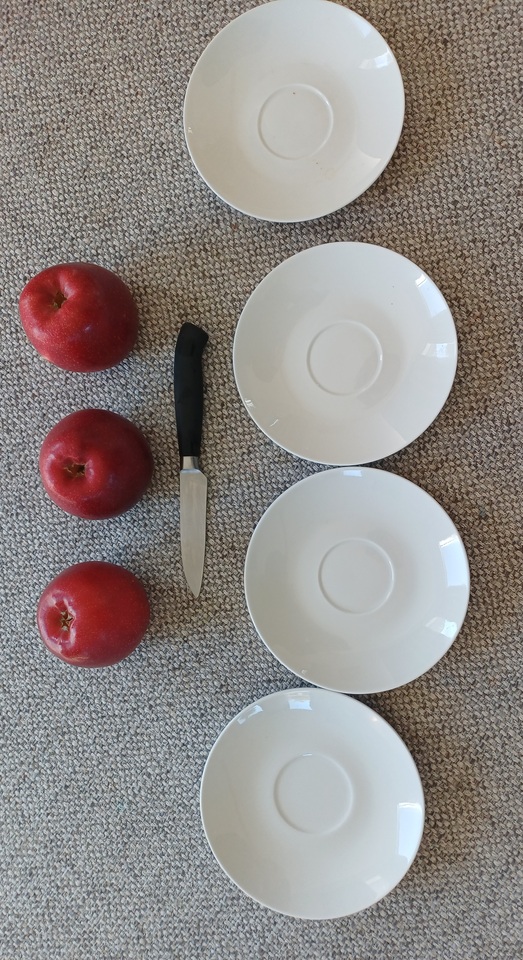
First, cut one apple into 4 parts – quarters.
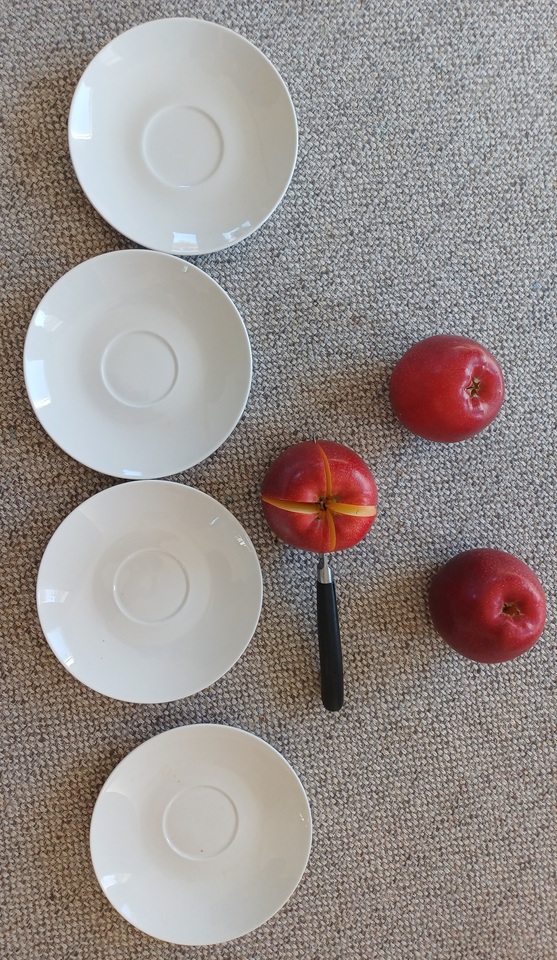
And put one quarter on each plate.
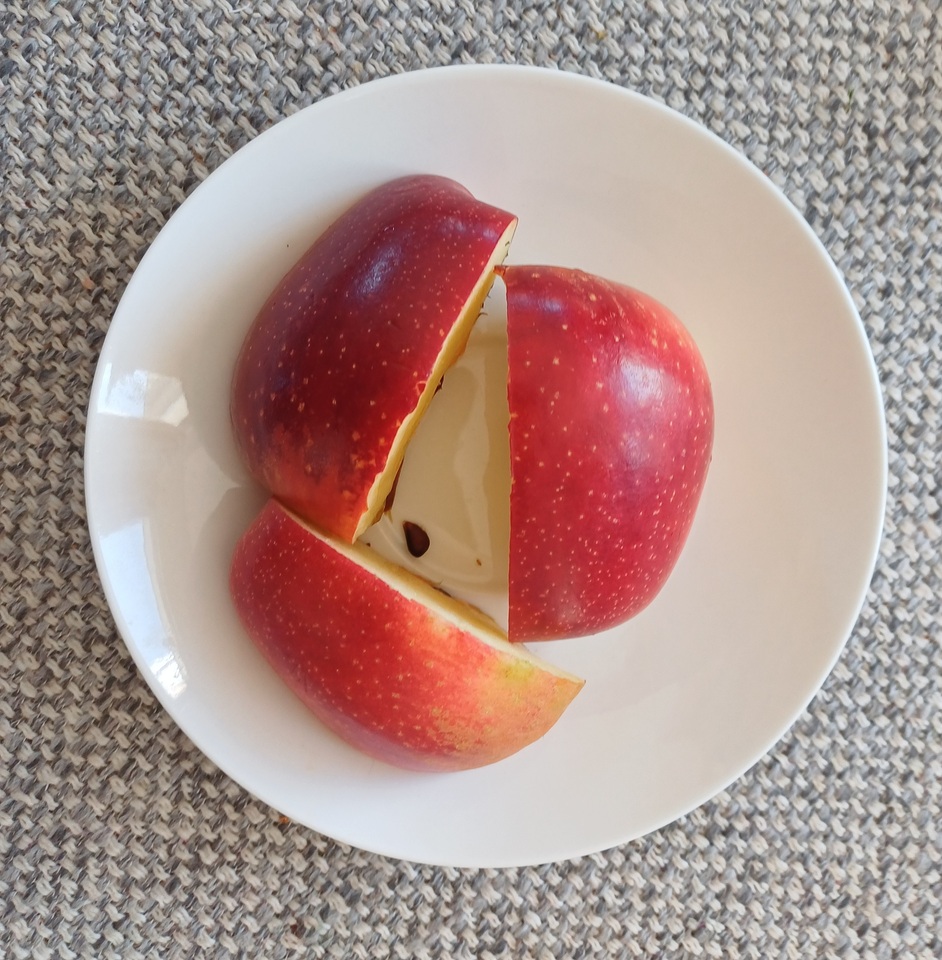
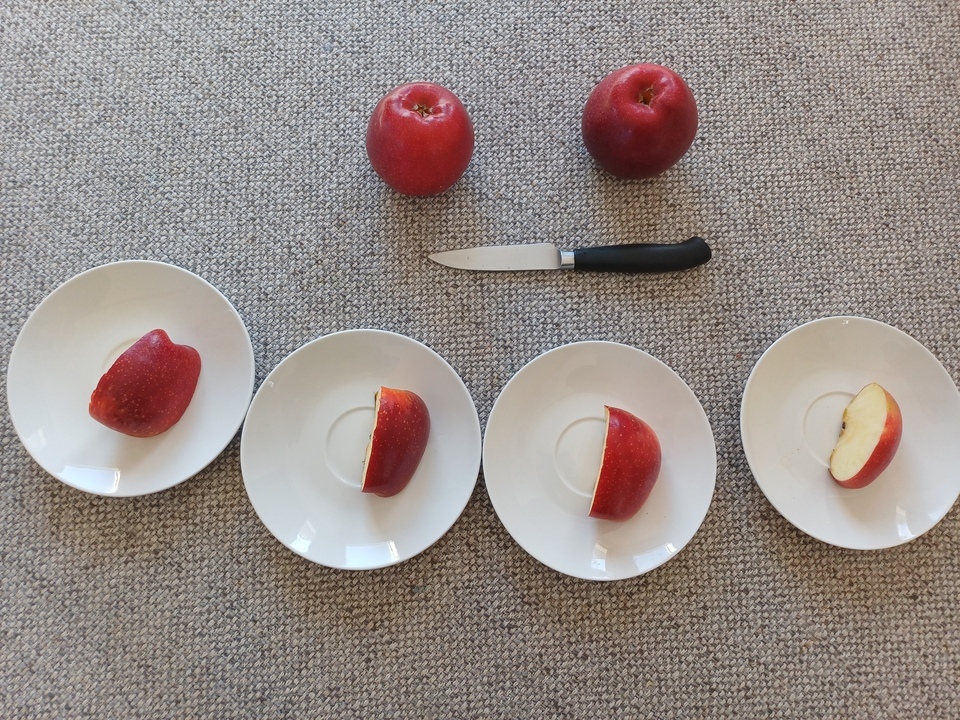 After all three apples have been quartered and shared, each plate will have 3 quarters of an apple. Even if one apple is bigger that the others, each plate will get the same amount.
Even with three different things, the process still works. Here the Dividend is three pieces of food to be shared between four people: The knife is dividing agent or operator.
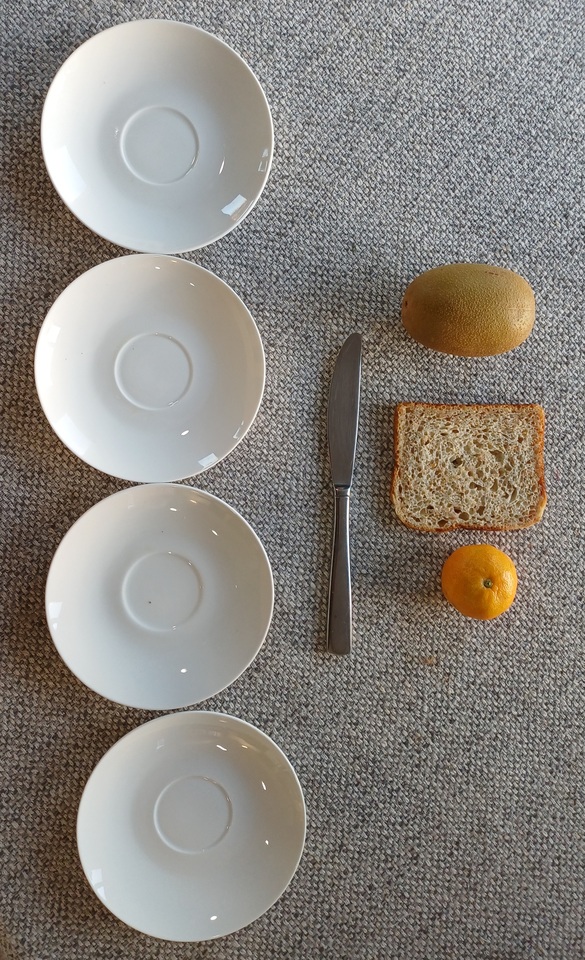
Becomes
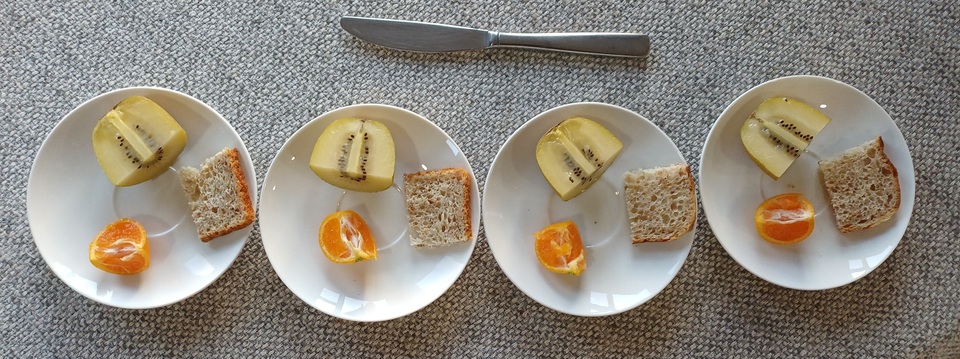
Numerically, we can show 3 shared between 4 in this way:
3

4
Or more simply
3
—
4
Twist the knife a little and you get 3/4 written in a single line, not three lines.
The symbols that we use can have interesting stories - can we find them - or - imagine them?
RB
More in the coming weeks
Posted: 29 May 2026