
Anthroposophy in Hawkes Bay
Events in brief for your diary
Friday 31 July to Sunday 16 August 2026
- Saturday 1 August from 9:30 am. School of Spiritual Science, Lesson 7.
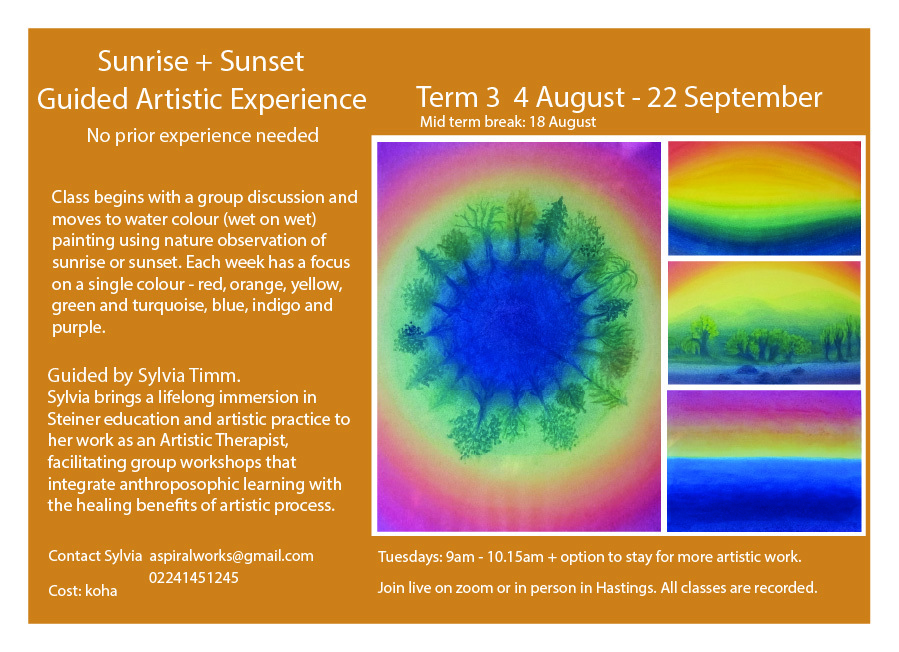
- Tuesday 4 August to 22 Sept. 9 to 10:15 am. Guided Artistic Experience- theme Sunrise and Sunset. (see ad for details)
- Friday 14 August, 7 to 8:30 pm. Friday Conversation Group meets in the Library. Study text is Christianity as Mystical Fact* 3rd edition. Chap 4 p63. "Plato as a Mystic".
Later in the year:
- Saturday 22 August. 2 pm. Memorial gathering for Mirra Arens in the Manukura Whare in Taikura.*
- First Saturday of every month, from 9:30 am. School of Spiritual Science. 5 September; 3 October; 7 November; 5 December.
- Friday 25 September, from 6 to 7:30 pm. Talk by Dr Richard Drexel "The Lung System - the mystery of Genesis and Phthora" in the Korimako Hall, Taruna.
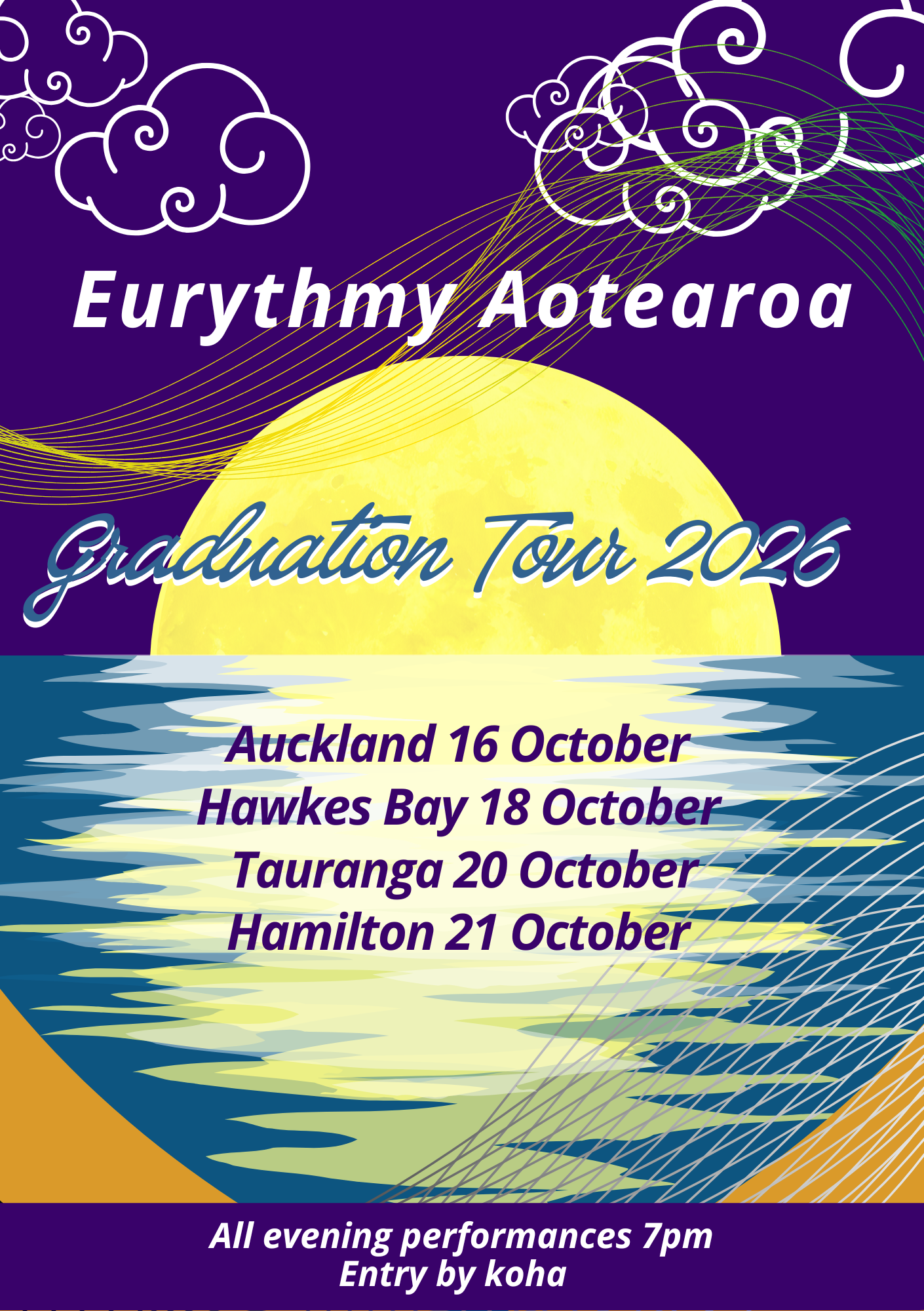
- Sunday 18 October, 7 pm. Eurythmy Aotearoa Graduation performance in Taikura's Hall.
~~~~~~~~~~~~~~~~~~~~~~~~~~~~~
Mirra Arens
Farewell to a fine teacher, friend and colleague.
~~~~~~~~~~~~~~~~~~~~~~~~~~~~~~
EURYTHMY AOTEAROA - Graduation Tour
We, the students of Eurythmy Aotearoa, are delighted to share some exciting news with you.
This October, we will be bringing our eurythmy performance to Auckland, Waikato, Tauranga, and Hawke's Bay. The programme marks the culmination of five years of study and artistic work, and we look forward to sharing it with you.
Join us for an inspiring evening of music, poetry, and the story of Kahukura. We warmly invite you to bring your family and friends.
Save the date in your diary now—we hope to see you there!
~~~~~~~~~~~~~~~~~~~~~~~~~
 ~~~~~~~~~~~~~~~~~~~~~~~~~~~
Charity and tax
For New Zealand's Inland Revenue Department (IRD), charitable purposes fall into four main categories:
- the relief of poverty,
- the advancement of education,
- the advancement of religion,
- and other matters benefiting the community.
For donors to make tax claims or get tax exemptions, the donee organization must be registered with Charities Services or approved by IRD.
Expanding the core charitable categories:
- Relief of poverty: Assisting people who are poor, financially distressed, aged, or facing severe hardship.
- Advancement of education: Advancing learning, schooling, teaching, or sharing knowledge, professional training, and academic research beneficial to the public.
- Advancement of religion: Supporting places of worship, religious instruction, spiritual practices of an organized faith, and spiritual teaching
- Other matters beneficial to the community: Public-good activities that do not fit the first three heads (e.g., environmental protection, community health, rescue services, and marae-based community functions). Helping the public in ways the law views as charitable.
Inland Revenue has a key rule for Claiming Tax Relief
Public benefit: The work must help a large part of the public, not just a few private people or family members. No private profit: Money cannot be used to pay personal profits to members or owners.
So, when we organise an event just for members or a closed group it is not seen as charitable in this broad sense.
Whenever people get tax relief for supporting activities set up for a limited group they reducing the tax available for the elected Government’s own ‘charitable’ activities. So, there is an ethical question therein.
I see this as a wake-up challenge for us to arrange or foster events that are open of of clear benefit to a wider public. We need people on the Committee who are keen to accept this challenge and seek to arrange events of broad interest arising from the insights of Anthroposophy.
Currently, the Centre is used by a number of Groups in the community:
- Eurythmy for Adults
- Te Kakano Play Group for Pre-schoolers
- After school Drama Classes for children
- Homeopathic Consultation
- Artistic Therapy
- Pastel Drawing classes
- Reiki
- Meditation classes
- A Mens Support Group
Their room hire covers a little more than 50% of the annual running costs of maintaining the Centre. The rest of the Budget we rely on koha and contributions from Members and Friends,
RB
~~~
The Brothers of Iron
In this segment of my “Foundation Stone Letters” I would like to take the idea of character when it comes to the elements a little further. These elements are the “songs”, the out pouring og beings of the second hierarchy, and in the study of them we acquire in insight into the “Character” of the beings themselves. The first imagination is the “array” of the elements into a “Periodic” table. It is consistent with that of a choir standing together and singing, each in their place and with their particular part. Aso, I start with the periodic table.
The periodic table is literally that, it lists the elements in a long line, starting with element number 1, hydrogen, the lightest and ending with elements whose existence is only seconds in nuclear reactors and whose assigned numbers are in the low 100s. An example of this is Muscovium, with a numer assigned to it of 115. This means it is 115th in the long list of elements. It has a “half-life” of only seconds and has been isolated in such small amounts that the amount could cover the tip of a human hair.
The elements are listed in lines or periods. Hence the name “Periodic Table”. The first line, or period, has two elements:- Hydrogen 1, and Helium 2. Then there are 8 elements per period for the next two. The first full period is:-
Lithium 3, Beryllium 4, Boron 5, Carbon 6, Nitrogen 7 Oxygen 8, Fluorine 9 and Neon 10.
This is a line of eight. An OCTAVE. Just as in music. The next line as also an octave and these elements deserve to be listed as well. They are
Sodium 11, Magnesium 12, Aluminium 13, Silicon 14, Phosphorous 15, Sulphur 16, Chlorine 17 and Argon 18.
As you can see, another eight. However, a pattern is emerging. Sodium is similar to Lithium and called Alkali metals. Magnesium is similar to Beryllium and these two are called Alkali-Earth metals. Carbon and Silicon have similarities too.
The “Pnictogens” is the name given to the group of elements starting with Nitrogen and Phosphorous.
The third line [period] starts with:-
Kalium [Potassium] 19, Calcium 20, and then would come Gallium as it is similar to Aluminium. BUT......we find a whole group of elements that are similar, and don’t appear to have any relation to their vertical column of elements [which is known as a group]. They are the elements I characterise as “the brothers of iron” after Fritz Julius, a Dutch Waldorf School teacher and scientist. These elements are:-
Scandium 21, Titanium 22, Vanadium 23, Chromium 24, Manganese 25, Iron 26. Cobalt 27, Nickel 28, Copper 29 and Zinc 30.
They appear in the middle of period 3.
And now, at last comes Gallium. The Groups continue with another “Pnictogen” Stannum, or [as it is usually known, tin], then Arsenic. Bromine and Krypton. The elements in the vertical columns are considered to be members of groups. Each group is related in properties to the other members of the group. The horizontal lines or periods, have elements that are related only slightly to their neighbours, but each period has widely different elements. The character changes as you progress across from say Lithium to Beryllium to Boron to Carbon to Nitrogen to Oxygen to Fluorine. [period two elements] However in the middle of this vast choir a collection of elements sticks out because of its homogeneity:- the “brothers of iron”. Sc, Ti, Va, Cr, Mn, Fe [iron], Co, Ni, Cu, and Zn. They appear after calcium in period 3.
Scandium is the first of these and would be absolutely unknown to anyone not in a highly specialised part of the aircraft industry. It is not rare, but is not found on its own, it is found in conjunction with other metals. It is closely allied with aluminium in character and is used to make aluminium alloys. Sometimes as little as 1% Scandium is needed to make a significant difference to the properties of aluminium used in the manufacture of aircraft. It is used in the metallic form, and being a metal similar to aluminium is easily alloyed with it.
Titanium is known in our hospitals. It is used where a metal plate is to be inserted in a human body to replace bone that has been lost. Pilots who fought in the Second World War have successfully lived many years with a titanium plate inserted in the skull, for example. Hip joints designed to replace worn out hips, can be made of titanium. It is a very light metal that is very strong. It resists corrosion. It is common but expensive to make from its ore. There is a large deposit of titanium oxide near the iron furnace by the Waikato river heads. It is extracted from the iron sand used to make iron. It is a white mineral and is used as a pigment in housepaint. It was used to make the very fast plane that could fly at 3 times the speed of sound, the Lockheed SR 71 Blackbird. It was a very difficult metal to use, but it was strong, light and resistant to melting in the heat generated by fast flight.
Titanium is rarely used pure. It is almost always used with small amounts of other metals and so are known as alloys. This is a highly specialised subject. If you come across something containing titanium it is certain to be expensive, as making and working these alloys is not something for the home garage. Titanium and its alloys are especially liked for implants in the human body, because of its unwillingness to react with the fluids of the body.
Titanium is very expensive to procure. This is not because it is rare.. it is not. It is in fact quite common. The difficulty is in refining titanium from its ore. Titanium is a metal that is known as resistant to attack by acids and rust. It has a high melting point so is used in applications where other metals would simply melt away. In a furnace, however, in powder form, it reacts very strongly with oxygen, so if you use the same method to extract titanium that you would to extract iron, you get nothing. Four or five separate processes are required where one is required to make steel. Although titanium is very useful, it is not cheap.
Vanadium is another of these “brothers of iron” that we are very unlikely to have pure in the hand, but may have often come into contact with in the steel we use. It is not an easy element to isolate from its ores even if it is not rare. Many hundreds of tons are used each year. It has recently been very expensive, but is now used universally in certain types of steel. Its favoured use is in “tool” steel. This steel is the kind used in metal lathes on the sharp edge that cuts steel being shaped on the lathe. Vanadium steel is very hard. A famous use of vanadium steel was by Henry Ford in his “tin lizzy” model T. It allowed him to make the components of the car thinner and lighter than if he had used ordinary steel. The vanadium steel, generally about 4% vanadium, is stronger, lighter and more corrosion resistant. This was one of the reasons the car was so popular.
Ford discovered this steel, so an anecdote relates, when he was watching a car rally, and a car disintegrated in front of him, a French car. He picked up a part of the car that had been thrown at his feet by the disintegration and took it home. He had it analysed by a friend of his. Informed that it contained Vanadium, Ford investigated its availability and possibility of use in car-building. The result was, that when he began to design and build the “T”, he used the Vanadium Steel he had had stumbled upon, to build his new car.
Technically the chemists of our time give these ten elements the name “First Transition Metals” They occur as metals in the middle of period 3 transitioning between calcium and gallium. These “brothers of iron” are the “real substances” of use in our technical age.
I will continue describing these “Brothers of iron” next letter.
Christopher Bacchus.
Posted: 30 Jul 2026