


Anthroposophy in Hawkes Bay
Events in brief for your diary
Friday 11 September to Sunday 27 September 2026
- Friday 11 September, 7 to 8:30 pm. Friday Conversation Group meets in the Library. (the meetings are held on the second and fourth Fridays of each month). The Study text is Christianity as Mystical Fact 3rd edition. Chap 5 p93. "The Wisdom of the Mysteries and the Myth".
- Saturday 12 September. 10 am to 1 pm. Exhibition of graduating Kairos students' art work.
- Friday 18 September. 10:30 am to 3:15 pm. Taikura Class 12 Project Displays will be open for the community to view.
- Sunday 20 September. 7 pm. Tania Diedericks Graduation Performance
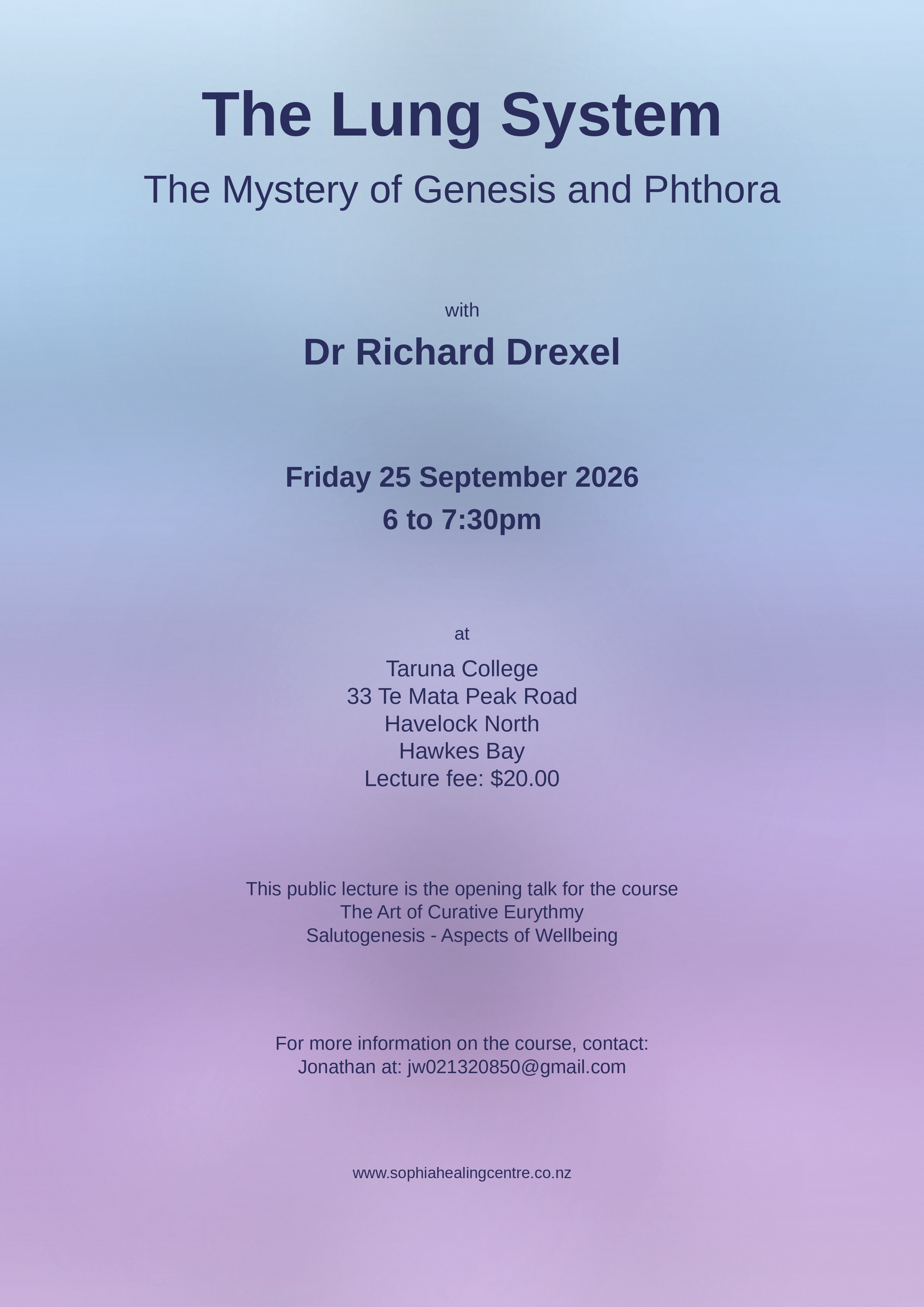
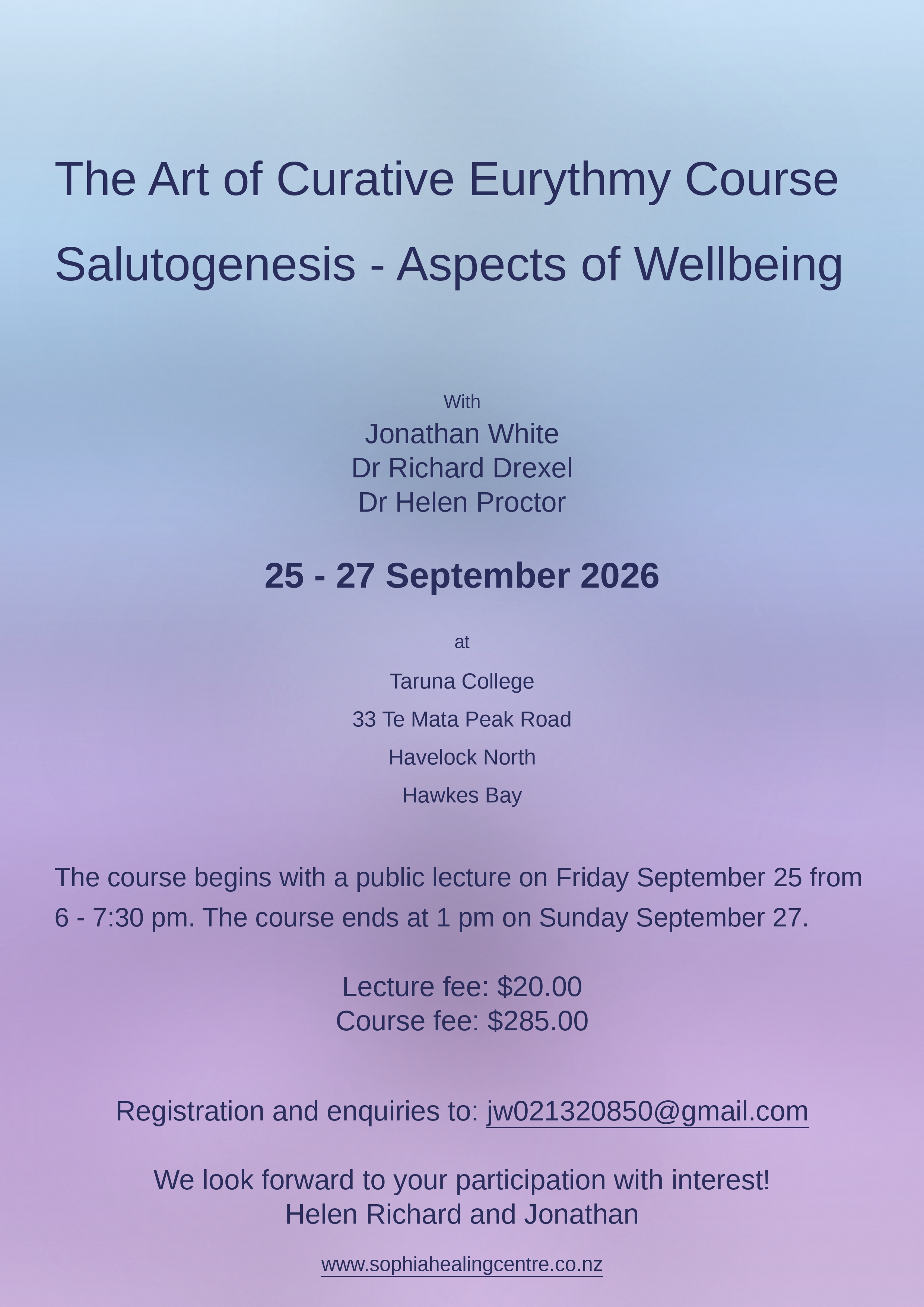
- Friday 25 September, from 6 to 7:30 pm. Talk by Dr Richard Drexel "The Lung System - the mystery of Genesis and Phthora" in the Korimako Hall, Taruna. This is part of
a COURSE on the Art of Curative Eurythmy. - Saturday 26 September. 7 pm. Centre. Showing of documentary on Goethe's Theory of Colour.
- Sunday 27 September. (NB Clocks +1 hour) 7:30 pm. SPRING FESTIVAL.
Later in the year:
- First Saturday of every month, from 9:30 am. School of Spiritual Science. 3 October; 7 November; 5 December.
- Sunday 18 October, 7 pm. Eurythmy Aotearoa Graduation performance in Taikura's Hall.
~~~~~~~~~~~~~~~~~~~~~~~~~~~~~
An Invitation to View Kairos Students' Work
We warmly invite members of the public to come and view the end projects and other work of two graduating Kairos students.
The exhibition will take place in the Art Room at the Anthroposophical Centre, on the corner of Whitehead Road and Nelson Street, Hastings, on:
Saturday, 12 September 2026
10.00 am – 1.00 pm
This is an opportunity to see something of the students' artistic work and the results of their studies at Kairos.
Finding the Art Room: After entering the building, take the left-hand hallway. The Art Room is the left-hand door at the end of the hallway.
All are warmly welcome.
~~~~~~~~~~~~~~~~~~~~~~
Taikura Class 12 Projects
The Class 12 Projects provide a wonderful insight into Taikura’s 25 graduating students as they near the end of their 12 year journey. For those who have been before you will know what a joy it is to listen to young people share their experiences and ideas.
In Class 12 students undertake a project which is based on their interests and in which they immerse themselves for nearly a whole year. These projects combine a practical and artistic element with research, and students present a theoretical document of 3,000-5,000 words, an artistic display and a public presentation to an audience.
These projects are part of the New Zealand Certificate in Steiner Education at Level 3, and students are assessed on each of the three components. On Friday 18 September, from 10:30 am until 3:15 pm, the Class 12 Project Displays will be open for the community to view in the School Hall. This is an opportunity for you all to see what the students have undertaken over the year, read their documents, and speak to the students directly about their projects. Asking the students questions about what they have been working on, why, and what they have learnt is helpful preparation for the question segment the following day. On Saturday 19 and Sunday 20 September you are warmly invited to attend the Project Presentations. Each student delivers their presentation, and then there is time for the audience to ask questions. These are formal presentations which will take place in the Hall. For details of students, their projects, and times of presentation, see the Taikura’s Grapevine.
https://taikura.school.nz/wp-content/uploads/sites/105/2026/09/GRAPEVINE-10-SEPTEMBER-2026.pdf
~~~~~~~~~~~~~~~~~~~~~~~~
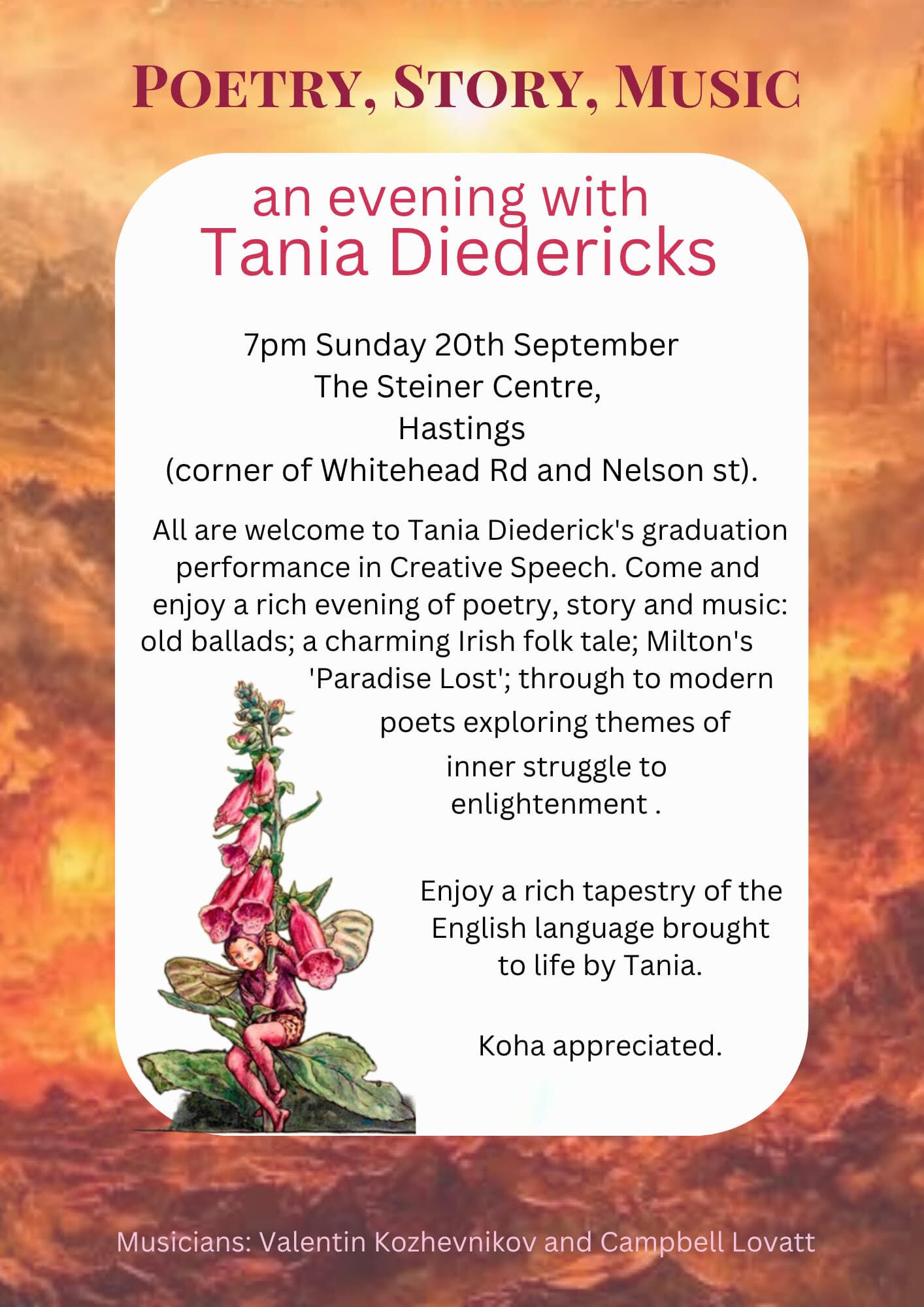
Tania Diedericks Graduation Performance
7pm Sunday 20th September
The Steiner Centre, 401 Whitehead Road.
All are welcome to Tania's graduation in Creative Speech. Come and enjoy a rich evening of poetry, story and music: old ballads; a charming Irish folk tale; Milton's 'Paradise Lost'; through to modern poets exploring themes of inner struggle to enlightenment. Music will enhance the evening.
Enjoy a rich tapestry of the English language brought to life by Tania.
Koha is invited.
~~~~~~~~~~~~~~~~~~~
Documentary on Goethe's Theory of Colour
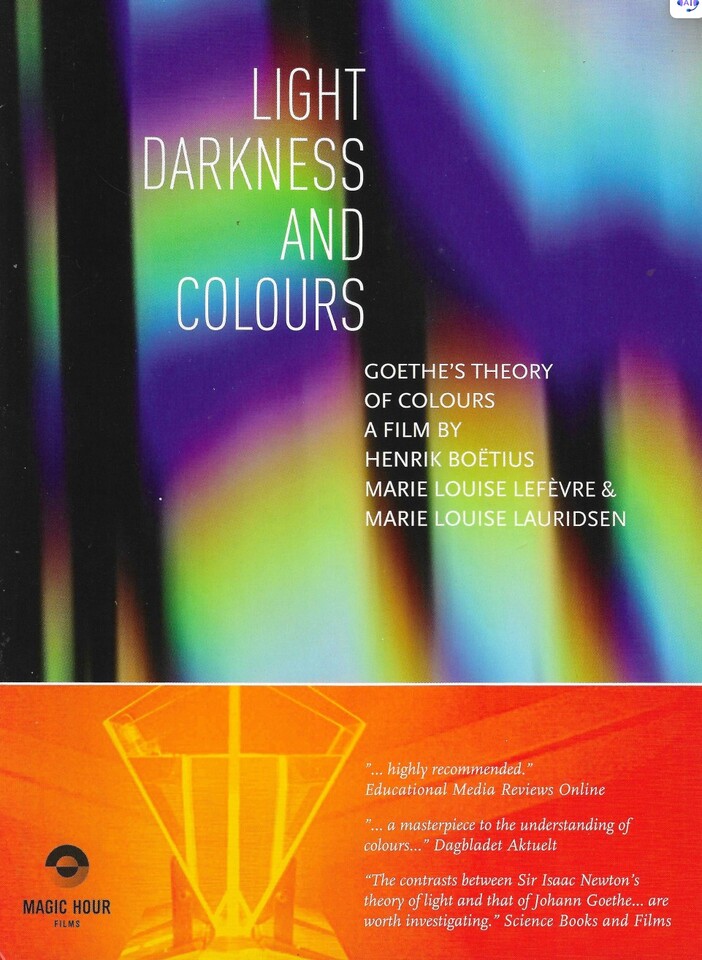
This 60-minute documentary will be shown in the Centre on Saturday 26 September at 7 pm.
John Jackson
~~~~~~~~~~~~~~~~~~~
Study Group on Refined Breathing
There has been some interest in the proposed 12-week study group exploring Steiner’s indications around Refined Breathing, but Wednesday does not seem to be a suitable day for people.
I’d still like to get the group going, so if you are interested, please contact me and let me know which days and times would work best for you. Based on the responses, we can look for a time that suits enough
people to form a group.
The study group will be held online, so you can participate from wherever you are.
If you’re interested, please get in touch with your preferred days and times.
Herman Veluwenkamp
My contact email is hveluwenkamp@gmail.com
~~~~~~~~~~~~~~~~~~~~~~~~~~~
Baroque Ensemble
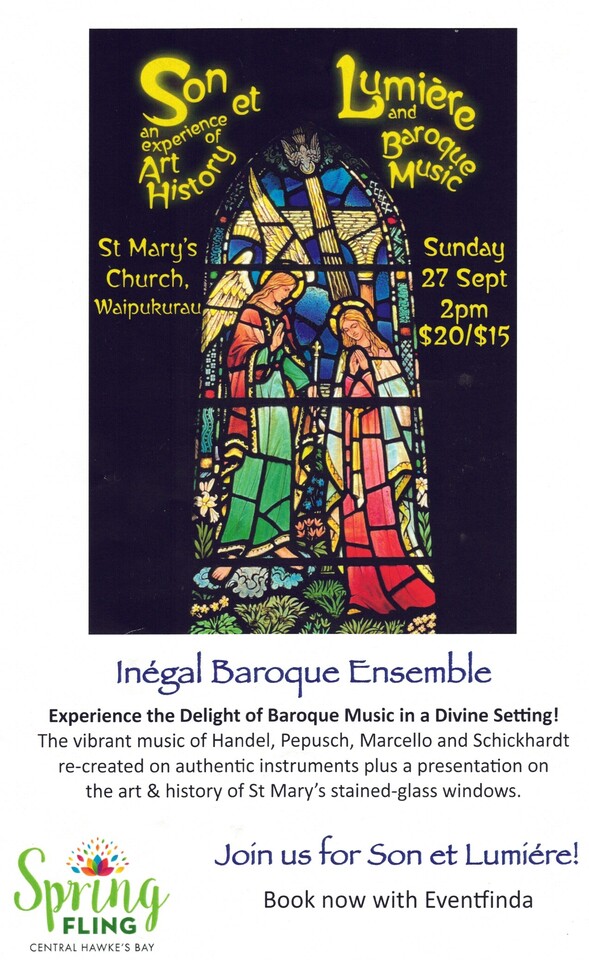
Three of the musical performers at this event in Waipukurau on Sunday 27 September are former Taikura students: Mark Menzies violin, Anita Gude viola, and Quentin Maioha 'cello.
~~~~~~~~~~~~~~~~~~~~~~~~~~~
Anthroposophic Meditation Week
Connecting to the Angelic World and to Christ
New Zealand
December 14 to 19, 2026, Mon-Sat
in the Āio Wīra Retreat Centre
8 Aio Wira Road, Waitākere,
www.aiowira.org.nz , 20 km from Auckland
Course leaders: Agnes Hardorp, Thomas Mayer
Times: Arrival day 6 pm - 9.30 pm,
seminar day 9 am - approx. 9.00 pm,
departure day 9 am - 2 pm
Course fee: 850 NZD, reduction possible
Accommodation: Between 350 and 650 NZD.
Meals: 325 NZD
To register: meditation333@protonmail.com
www. anthroposophical-meditation.info
See POSTER
~~~~~~~~~~~~~~~~~~~~~~~~~~
Arithmetic Musings 19
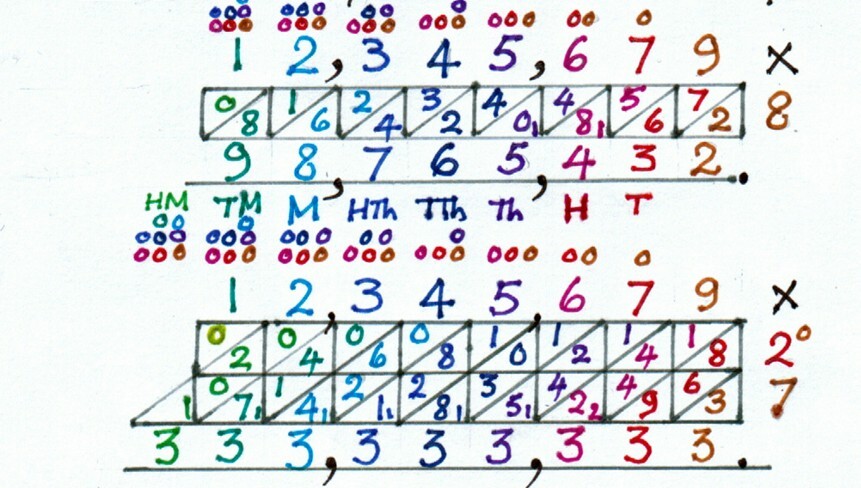
A couple of interesting examples using John Napier's lattice method of multiplying:
The one servant with clean hands had a dirty conscience!!!
Back to mathematics.
Napier note that addition was a much easier process than multiplication. So, he sought a way to use a process involving addition to replace multiplication. The result was Logarithms which he took 25 years to develop and complete.
In Europe, there were astronomers exploring the shapes of the planetary orbits - were they circular or elliptical? This involved the very precise measurements made by Tycho Brahe and the mathematical equations devised by the famous German astronomer Johannes Kepler. These involved much multiplication of large numbers.
Before logarithms were published by John Napier in 1614, astronomers spent months or even years doing heavy multiplication and division by hand.
Johannes Kepler extensively used John Napier's book of logarithm tables to calculate planetary orbits. They radically sped up his mathematical work.
- Kepler spent years charting the positions of stars and planets using the data collected by his mentor, Tycho Brahe. By turning tedious multiplication into simple addition, Napier’s logarithms allowed Kepler to finish his Rudolphine Tables, the most accurate planetary astronomical map of its era.
- Discovering the Laws of Planetary Motion: Kepler used the log tables to discover his Third Law of Planetary Motion (which shows the exact mathematical relationship between a planet's distance from the Sun and the time it takes to complete an orbit).
- Developing His Own Explanations: Kepler was so fascinated by logarithms that he wrote a book in 1621 to explain how they worked using different mathematical proofs than Napier. He officially dedicated his Rudolphine Tables in part to Napier's memory.
RB
Posted: 10 Sept 2026