

We warmly invite you to three events
Celebrating the First Goetheanum.
All events at the
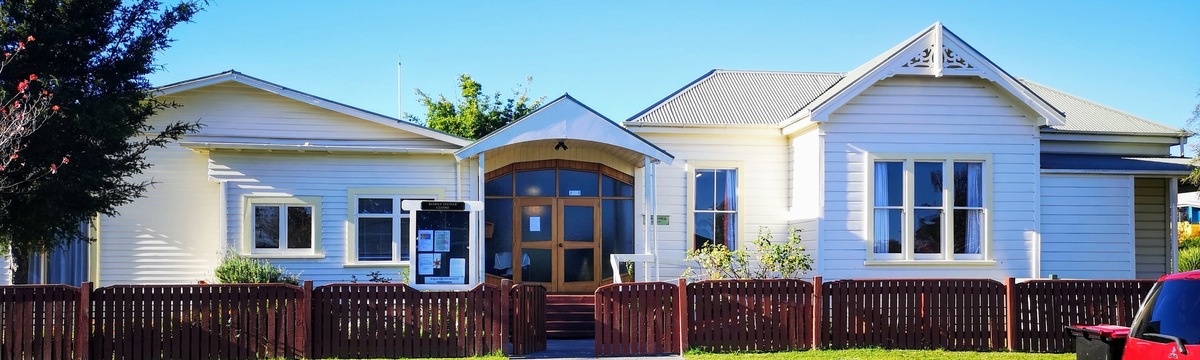
Rudolf Steiner Centre
401 Whitehead Road, Hastings
1
Opening of an Exhibition of
“Art Related to the First Goetheanum”
Saturday, 17th December, 2022
3:30 p.m.
Afternoon tea and Welcome
talks:
‘The Goetheanum model’ (gifted to New Zealand in 1980s) -- by Robin Bacchus
‘The Spiritual Journey of the Human Being as Expressed in the Art Forms
of the first Goetheanum’ -- by Hans van Florenstein Mulder
*****
2
Guided Toursof the Exhibition
“Art related to the First Goetheanum”
are on:
Monday 19 December, from 5.00 - 6.00 p.m.
Wednesday 21 December, from 2.00 - 3.00 p.m.
Wednesday 28 December, from 2.00 - 3.00 p.m.
Thursday 29 December, from 5.00 - 6.00 p.m.
The spiritual stream will only be able to introduce the new culture, as is its task, when granted the opportunity to work right down into the physical design, the very walls of the buildings that surround us. And spiritual life will have quite a quite different effect when it flows from the spaces whose dimensions are determined by the science of the spirit, whose forms have been created on the basis of spiritual science.
Rudolf Steiner, 3 January 1911.
3
A gathering
Commemorating the loss of the first Goetheanum
which was destroyed by fire 100 years ago.
Saturday, 31st December
3.30 p.m.
“The year 1922 and the burning
of the first Goetheanum”
Talk by Hans van Florenstein Mulder
- Conversation arising from the talk.
- Sue Simpson will lead us in eurythmy.
- At 6.00 p.m. there will be a shared meal.
Please bring a plate of food for this festive occasion.
* * * * * *
In the early beginnings a small group of interested people was involved within the Anthroposophical Movement ….
The world only began to really take notice of Anthroposophy when the intention to build the Goetheanum began to be put into effect.
Adapted from Rudolf Steiner’s
“The Constitution of the School of Spiritual Science.”
Rudolf Steiner’s main purpose in designing the Goetheanum was to create a synthesis of the visual arts, within an architectural setting, which revealed spiritual realities usually hidden from everyday consciousness. He incorporated the arts of painting, sculpture and coloured glass engraving. {The building created a space for the performing arts of speech, drama, music and eurythmy.} Rudolf Steiner was also interested in exploring how the medium of the visual arts can convey the results of spiritual-scientific research in a manner not possible through the use of words.
Adapted from Christian Thal-Jantzen ‘s Introduction to
“Architecture as a Synthesis of the Arts”
Picture drawn by Hansjörg Palm
These events organized by an Initiative Group that meets regularly at the Rudolf Steiner Centre, Hastings –
Hans and Ineke van Florenstein Mulder, Bernie and Gerrit Raichle,
Margaret Stevenson, Jenny Sutherland, Diana and Robin Bacchus.