


Anthroposophy in Hawkes Bay
Rudolf Steiner Centre, 401 Whitehead Road, Hastings
Events in brief
over next 2 weeks
25 January to 8 February 2026]
- Friday, 30 January. Christian Maclean - will give a talk at Rangimarie entitled: “Epiphany: the Adoration of the Magi and the Baptism in the Jordan”
- Saturday 31 January. 10 am. Pan Eurythmy in Cornwall Park.**
- The Wednesday group meeting at the Centre will commence in the New Year on Wed 4th Feb 2026. We will continue with reading "The Spiritual Origins of Eastern Europe and the future Mysteries of the Holy Grail"
~~~~~~~~~~~~~~~~~~~~~~~~~~~~~~~~~~~~~~~~~~~~
- Monday 9 February. 8:30 am. Conversation and Coffee at the Centre**
- Friday 13 February. Opening of Sophia Pharmacy**
- Friday 13 February. 7 pm. Friday Study Group resumes studying Karmic Relationships VIII
- Friday 20, Saturday 21 February. A celebration "Earth Radiating Spirit" **
- Saturday 28 February: Humour and Rudolf Steiner the Cartoonist with Van James from Hawaii.
- Thursdays 5, 12, 19 March 7 pm. Talks by Cleone Armon: "The Evolution, Development and Destiny of the Animals" in Art Room.**
- Saturday 14 March. 2:30 pm. Special General Meeting of the Branch to consider Change of HBBranch Rules/Constitution. We are required by the Charities Commission to review these every 3 years to ensure that they are "fit for purpose".
Committee News
If you feel you would like to contribute to the running of the Centre and join the Committee, please contact me.
With our financial year commencing in April, members have the opportunity, between now and the end of March, to suggest new books for the library in the new financial year.
All book suggestions will be collated and the Committee, together with the librarian, will make a final decision which books to purchase.
For the Committee
Gerrit
Please click this link for full details of this event:
~~~~~~~~~~~~~~~~~~~~~~
**Pan Eurythmy practice
will be happening next Saturday 31st Jan at 10 am. We will meet at Cornwal park, the circular garden by the hot house. weather permitting. We will go through the exercise sequence 1 to 10. A brief explanation of the meaning behind each exercise is given here.
Pan Eurythmy exercise 1 to 10 explanation
1. Awakening to our higher self, the divine in all of us. How it connects us all. Every movement must have the divine in it. We become truly human when we awaken to the divine in us. A sign of this awakening is that we want to give to the world what has been born inside us. New things come from the inside…
2. Reconciliation, the actions here express softness and reconciliation, with the challenges of life. They teach us to reconcile the contradictions in life through softness. Peace both inner and outside us. This peace is a divine being that lives within us.
3. Giving, when we give to others we become a vehicle for the divine within us. Strong people give. When we give we purify ourselves. Those who love give.
4. Ascending, we understand that life is our teacher. We can learn from everything if we understand this.
5. Elevation, we accept the new divine in us. Leaving the old in the past.
6. Opening, to thoughts and feelings, the right side representing the thoughts, the left to the feelings. Opening to love and presence.
7. Liberation, to move on we must cast off what is old and of the past. Casting off of old karma as preparing for a new life of doing the good.
8. Clapping, finding the joy in nature. Rejoicing in the good that comes through us.
9. Purifying, working to maintain spiritual cleanliness.
10. Flying, yearning to live in the light.
For further info
https://www.youtube.com/watch?
See you there
John and Tara
~~~~~~~~~~~~~~~~~~~~~~~~~
Speech Course Notice:
Dear members and friends of the Anthroposophical Society,
We are having a visiting tutor, Penelope Snowdon-Lait from Christchurch, offering a Speech and Drama Course in Hawke’s Bay, in February, with local colleagues assisting her.
This is closely linked to the theme of "Earth Radiating Spirit" A Celebration of the Foundation Stone of the Goetheanum also in February.
St. Francis of Assisi wrote:
“Praised be my Lord for our sister, the bodily death,
From the which no living man can flee.
Woe to them who die in mortal sin;
Blessed those who shall find themselves in Thy most holy will,
For the second death shall do them no ill.”
He was aware of the inner transformation we can bring about when we ‘die before we die’ – which means: “letting go of the personal, imperfect self – taming our astrality (animal world), to prepare for the coming of our Higher Self”
This is a level of consciousness brought about through work with drama and the sacred use of speech in the Mysteries of Ancient Greece. Looking towards the future development of consciousness, the personal element has to be transcended, and drama, in the way demonstrated in Rudolf Steiner’s Speech and Drama Course, becomes a tool towards this aim, both for the training of acting, as well as for the stage, showing transformative pictures, enlivened by the cosmic forces of the planets and the zodiac, in the vowels and consonants of language. This is exciting higher learning, linking us to the spiritual in a very practical way, involving all parts of our being.
In the Foundation Stone Meditation, our soul, in the limbs, the heart and the head is being called upon to work at transformation.
But what is Spirit-remembering (remembering in the spirit), and how can you practise it?!!! – likewise Spirit-Awareness (not just on a day-to-day physical level..?) – and what about ‘Spirit-Beholding’?
These seem to be tall orders of a rather intangible kind...
However, when our whole being, with body, life-energy, soul and spirit is involved in a process manifesting the spiritual on stage – working with drama in a new way, perhaps we can come closer to the inspirations needed, to begin to meditate in a new way too?
This course is for anyone who would like to experience raising drama, and speech, to a level of consciousness, where the audience can experience the spiritual, a consciousness for society of the future.
No prior knowledge is needed for this, just openness and willingness to jump in and experience something new.
For those who wish to go somewhat deeper, you are welcome to stay on for the second part of the morning, where we will go more into drama work.
Costs and further details are on the poster.
We would appreciate early enrolment, to gauge the number of committed participants.
With warm regards,
Astrid Anderson,
On behalf of the Tutors of “Spirit of the Word”
(021 215 4019 or starguide@xtra.co.nz)
Mondays from 9th February at 8:30 am
Fridays from 13th February at 1:30 pm
Starting second week in February - 9th
For those of you who wish to help with the above initiative, please send
me an email to chrsbacchus@gmail.com
I will make a roster so that people can be there at those times to help.
I expect there to be only a couple of people in for coffee and conversation.
One person [plus yours truly] should be enough.
The coffee and conversaton should end Mondays 10:30 am; Fridays 3 pm.
Christopher Bacchus
Request
I was wondering if any readers might have copies of Jakob Streit’s books that I could borrow —
"And There Was Light",
"Journey to the Promised Land",
"We Will Build a Temple".
I’m currently reading them as an online .pdf to my 9 year old, but it would be wonderful to be able to read them together from a physical book.
Amaali Shaw
email amaali@pm.me
**A visitor from Scotland - Christian Maclean - will give a talk at Rangimarie on Friday, 30 January, entitled:
“Epiphany: the Adoration of the Magi and the Baptism in the Jordan”
Christian has been an Editor for Floris Books for many, many years (and still is!) and for some recent years is a member of the Christian Community Foundation - a group that supports The Christian Community founded in 1922 as a free church, in the area of the donation of the sacraments, teaching, pastoral care and the training and ordination of men and women as priests and of their sending in Europe and overseas.
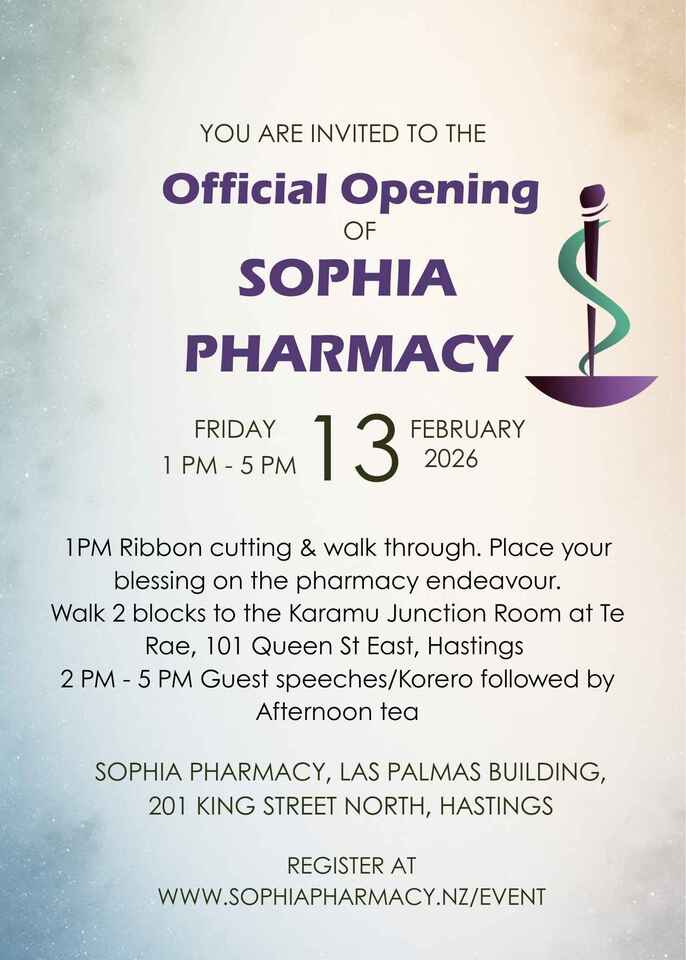
**INVITATION to the OFFICIAL OPENING of the SOPHIA PHARMACY
You may be aware that in October 2025 I completed a process, with the full support and guidance of the Medicines Control team at MEDSAFE, and was granted a licence to operate a pharmacy; an integrative healthcare pharmacy specialising in anthroposophic medicines.
What had been my clinic and dispensary as Healing Lands is now Sophia Pharmacy. The Healing Lands brand is still used for making various products.
To ground the pharmacy within the wider community, an opening is to be held on Friday February 13th. At 1pm is the ribbon cutting and walk through at Sophia Pharmacy where you are invited to place your individual blessing. At 2pm, at Te Rae, 101 Queen St East (5 minute walk from the Pharmacy), will be the reception with guest speeches/korero and afternoon tea kai.
I warmly invite you to be a part of the celebration, to help bring this new venture, founded in anthroposophy, to be active in the world.
More details for the afternoon are on the Sophia Pharmacy website.
Please register your attendance for our planning. Use this link Sophia Pharmacy
If you are unable to be there and would like to be in contact the email address is hello@sophiapharmacy.nz
I look forward to seeing you on the 13th.
Warm regards
Nic Parkes
Sophia Pharmacy
Las Palmas Building, 201 King Street North, Hastings
~~~~~~~~~~~~~~~~~~~~~~
The Evolution, Development and Destiny of the Animals
Free talks at the Centre in the art room.
Thursday evenings, 7-8pm, March 5th, 12th, 19th.
Anthroposophy speaks of Creation as being both evolutionary and spiritual — a gradual development which was, and still is, guided and influenced by advanced spiritual beings.
These talks, given by Cleone Armon, are illustrated and explained with her own art work.
~~~~~~~~~~~~~~~~~~~~~~
**Goetheanum's Foundation Stone
In Hastings we will be celebrating the arrival of a bronze sculpture, created in 2023 by the Dutch artist, Rik ten Cate on 20 and 21 February as "Earth Radiating Spirit" (see above).
This double pentagonal dodecahedron, a replica of the Foundation Stone, laid by Rudolf Steiner in 1913 for the first Goetheanum and still under the second, is closely connected with the Foundation Stone Meditation given at Christmas, 1923.
Having already visited Chile, Brazil and Germany, this sculpture arrives soon in Australia, and then comes across to Aotearoa New Zealand in early February, 2026.
As the double pentagonal dodecahedron
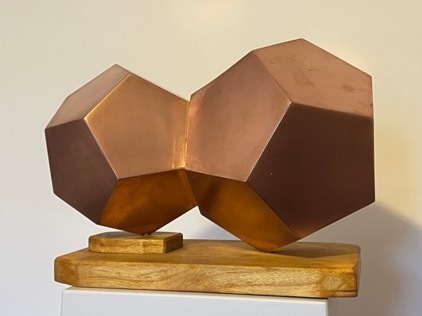
is a geometrical form, I am offering some musings on some relevant GEOMETRY in the intervening weeks, as background. RB
Musings on Geometry 4
Last week, we explored the themes of centrality and symmetry.
This week we will look at an early philosopher, Pythagoras and a famous Geometrical Theorem related to Right Triangles, bearing his name.
In essence this theorem can be stated as:
"In any triangle with angles A, B, C opposite sides a, b, c:
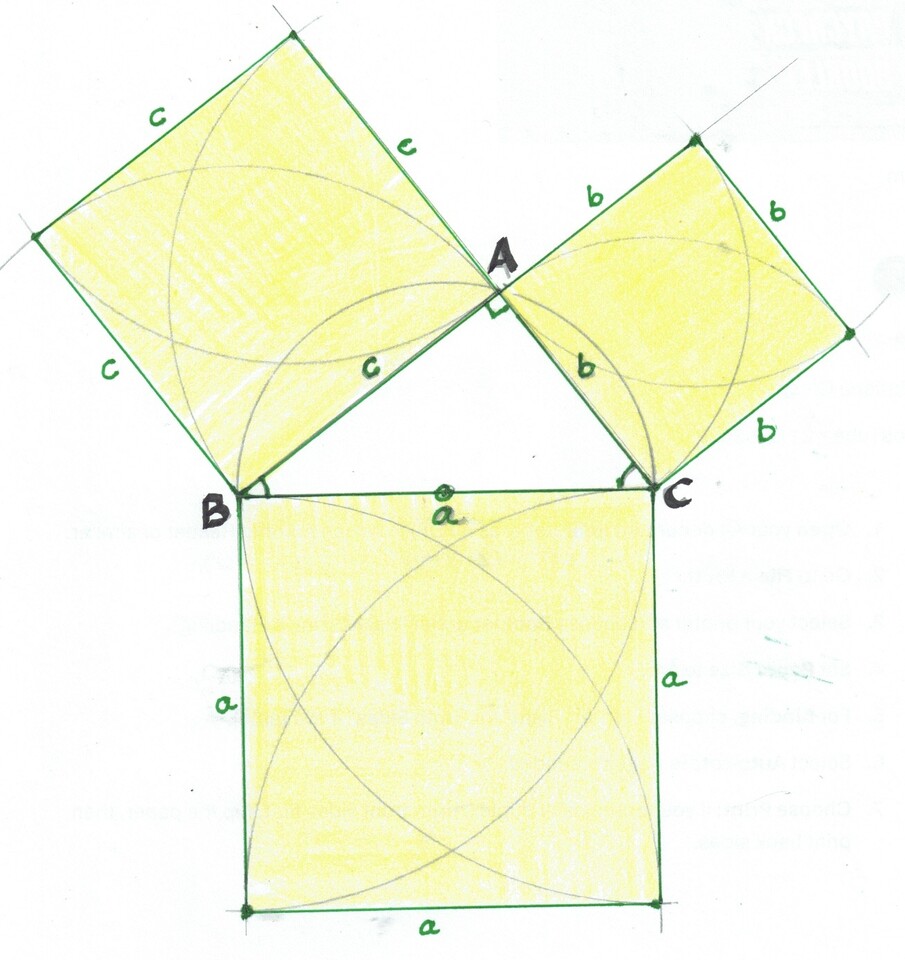
The angle in a semi-circle is a quadrant or quarter of a full turn, or 90º (see A in diagram).
If A = B + C = 90º [sizes of the angles] then a2 = b2 + c2 [areas of the squares]
Note the similarity of form - the pattern!
The following Powerpoint slides exploring the theme are best viewed on a computer (wide) screen, not a mobile (tall) screen!
The 'Great Initiate' Pythagoras of Samos.
Exploring the famous Pythagorean geometrical theorem.
RB
This Newsletter
This Newsletter is a gift to the people of Hawkes Bay, or indeed of anywhere if they care to subscribe -- without cost.
You can access the past 6 months issues by going to www.anthrohb.nz and looking under the News tab.
However, Anthroposophy Hawkes Bay does have the real expense of maintaining the Rudolf Steiner Centre in Hastings, [basically: Rates, Electricity, Insurance, Cleaning and Garden care] which costs us $40 per day, so we do need real income if we are to retain the privilege of having a dedicated meeting place for people of the Hawkes Bay district interested in Anthroposophy.
Gifts can go both ways. If all readers gift us only $5 (the price of a cup of coffee) per month by AP, we can manage easily.
For those who would like to consider making a small, regular gift, here are the details:
Kiwibank 38-9016-0511420-00
The Hawkes Bay Branch of the Anthroposophical Society in New Zealand
• Particulars: «Firstname»
• Code: «Surname»
• Reference: Donation
The HB Branch of the ASNZ is registered with the Charities Commission as a charitable organisation [CC30527], so you will be eligible for IRD tax refund of 33% for your charitable donation over $5. You will receive an official receipt from the Treasurer for this purpose soon after the end of the tax year on 31 March 2026.
Many thanks to those readers who have already responded to this request.
RB


Posted: 24 Jan 2026