


Anthroposophy in Hawkes Bay
Rudolf Steiner Centre, 401 Whitehead Road, Hastings
Events in brief for your diary
Friday 10 July to Sunday 26 July 2026
- TODAY: Matariki Holiday marks the start of the Maori Year, about 3 weeks after the shortest day (so the lengthening of daylight is just noticeable), and the Matariki constellation is visible to the north of east in the hours before dawn.
- Friday 10 July, 7 to 8:30 pm. Friday Conversation Group meets in the Library. Study text is Christianity as Mystical Fact* 3rd edition
- MONDAYS 13, 20, 27 July 7 pm. Conversations on the Christmas 1923 FOUNDATION STONE**
- Saturday 25 July. 2 pm. Anthroposophy Hawke's Bay AGM. Approving a new Constitution.
- Saturday 25 July, from 3:30 pm (after AGM) to 5 pm. Talking, Listening, Caring. Invitation
Later in the year:
- First Saturday of every month, from 9:30 am. School of Spiritual Science. 1 August; 5 September; 3 October; 7 November; 5 December.
~~~~~~~~~~~~~~~~~~~~~~~~~~~~~~~~~~~~
HEATPUMP
The heatpump (air conditioner) has just been serviced and should be working better. Please ensure it switched off properly - watch to see that it closes - it may be a bit slow, so don't press the switch a second time, as that might re-open it or turn it on again.
Thank you in anticipation.
~~~~~~~~~~~~~~~~~~~~~~~~~~~~~~~~~~~~
Our Society’s Constitution.
A warm thank you to those members who came to the Consultation Meeting last Saturday.
Various clauses were clarified and the Revised Constitution made ready for presentation at the AGM. Please read it before the meeting, as it will be taken as read. See AGM Agenda.
~~~~~~~~~~~~~~~~~~~~~~~~~~~~~
Charitable donation Receipts for IRD tax relief.
In early April, as Treasurer I sent out (so I thought) official receipts to all those who made donations. The letters were created, but Outlook failed to send them, as I discovered when people started enquiring where their letter was. A few days ago I repeated the exercise, so I trust a Receipt has reached everyone. When applying for a tax refund you will need to know that our IRD# is 101-435-873.
If you still have not received your Receipt, please email me on robin@bacchus.co.nz
~~~~~~~~~~~~~~~~~~~~~~~~~~~~~
The Foundation Stone Meditation
given in Dornach at the site of the burnt-out First Goetheanum. This FSM was laid by Rudolf Steiner into the hearts of members, making it a significant moment in the evolution of the Anthroposophical Society. It took place at the Christmas Conference of 1923/24 and was attended by a large group of members of the Society. It was the last Christmas Conference Rudolf Steiner attended. The following year he was bedridden and unable to attend.
How significant was this occasion in reality? Views will differ from member to member. Sergei Prokofieff was sufficiently convinced of its importance to write three large books, “Rudolf Steiner and the Founding of the New Myasteries”, “May Human Beings Hear It”, and “The Foundation Stone Meditation”. I have read all three of these books [twice] and have found that he has invested a lot of time and thought to the texts. Amazingly, in the course of some more than two thousand pages he doesn’t repeat anything, unless it is to illuminate the topic from another side. He makes some rather startling assertions in the texts of these books. From the history of the creative beings who fashioned the earth, to hints about the kind of evolution of humanity after the Vulcan evolution [of the earth.]
After all this study, I am convinced it is still worth continuing. I do hope you will join me Mondays of July at 7pm in the centre.
Mondays 6th, 13th 20th and 27th. The four evening fit neatly into the available Mondays of July, so we could call this July a “Foundation stone Monday Month.”
Christopher Bacchus
~~~~~~~~~~~~~~~~~~~~~~~~~~~~~~
Arithmetic Musings #15
Even Numbers and time - in particular musical harmonic frequencies.
Here are some pebble patterns using Even numbers on the left and Odd numbers on the right, where a new one is introduced into the even pattern.
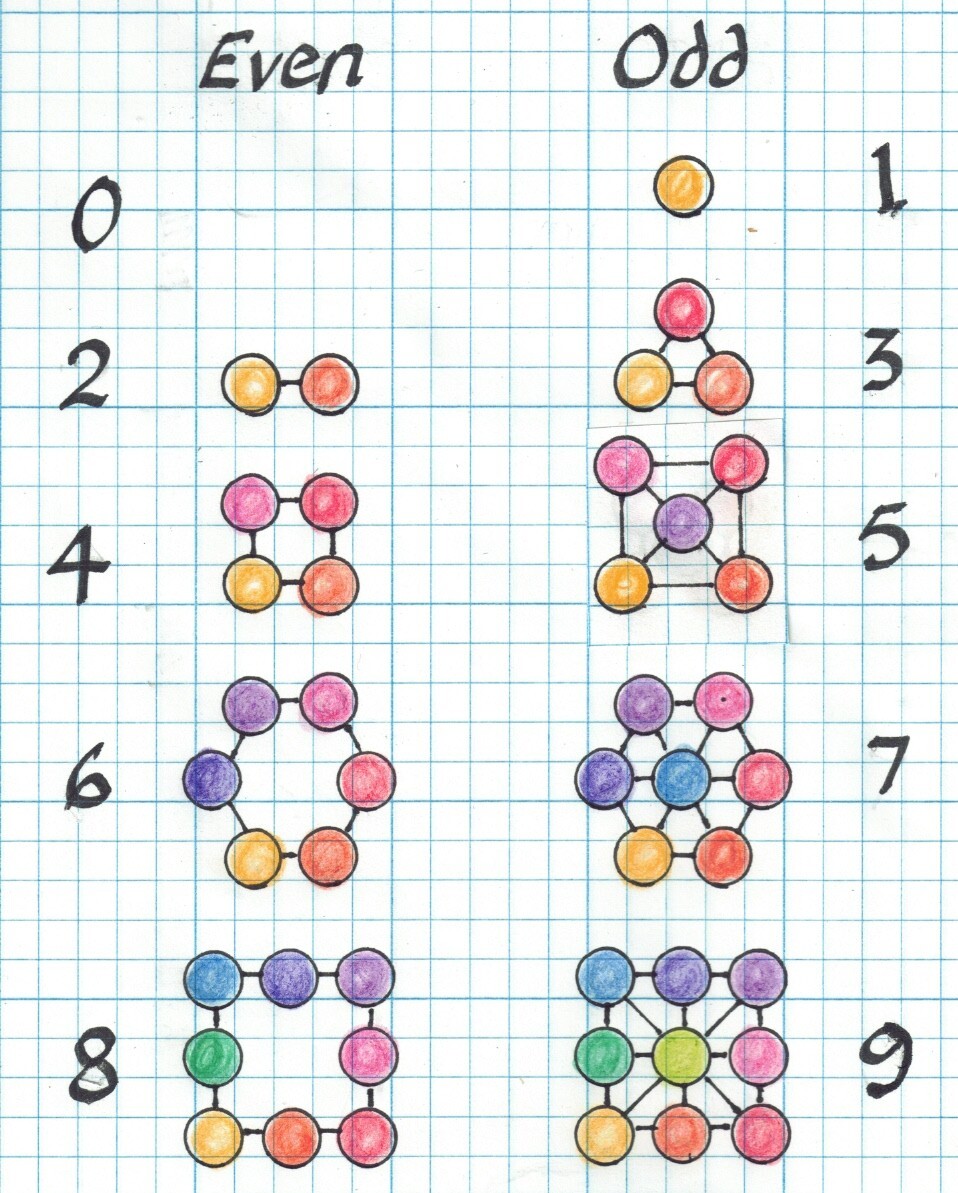
In the next picture, even-numbered lines of pebbles are formed into areas, building into larger areas.
The first diagram there is a rectangle 1 high by 2 wide; ratio 1:2;
next diagram the diagram has grown to 2 high by 3 wide; ratio 2:3;
next diagram the diagram has grown to 3 high by 4 wide; ratio 3:4;
next diagram the diagram has grown to 4 high by 5 wide; ratio 4:5;
next diagram the diagram has grown to 5 high by 6 wide; ratio 5:6.
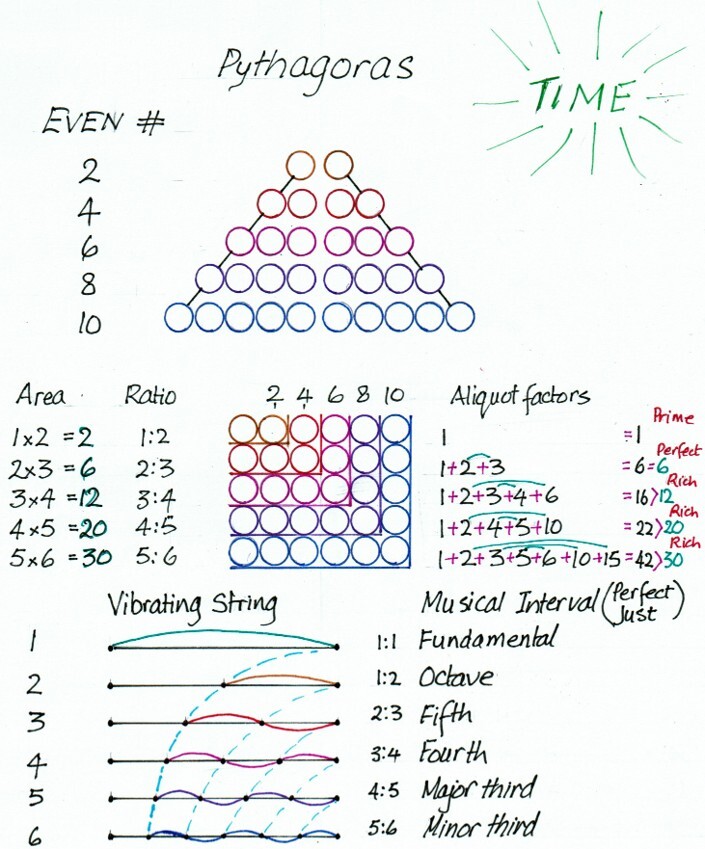
Pythagoras was interested in musical harmony and the ratios between lengths of vibrating strings.
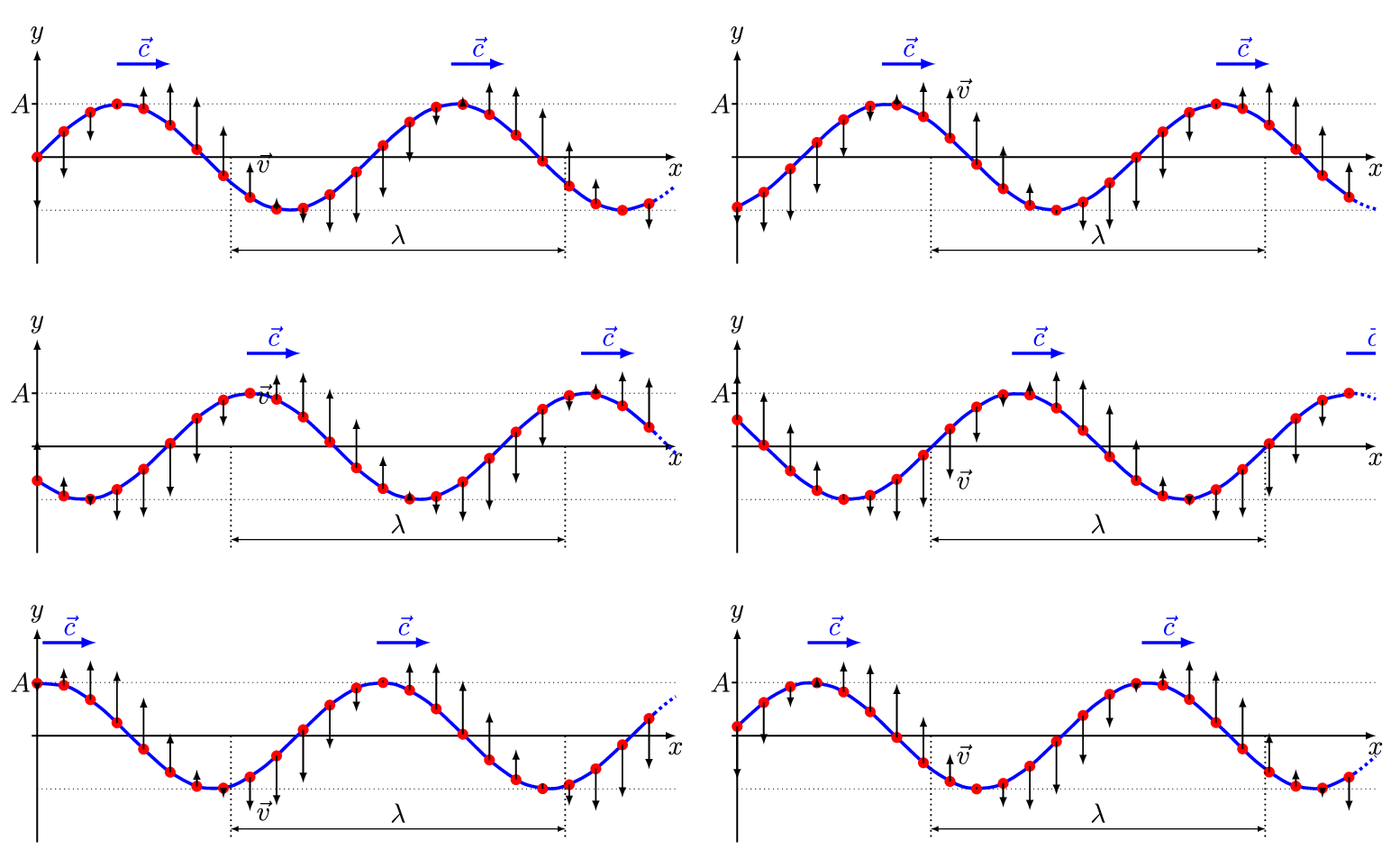
When a solid, but flexible object, such as a taut string, is struck, shaken, plucked, bowed, etc., it is deformed slightly; this deflection pulls the neighbouring part with it, so that the deflection passes along like a wave. Then there is a correcting influence that pulls the stretched wire back to its original place, but it goes too far in the opposite direction.
This picture shows the alternating action as a travelling wave:
If many things are vibrating at the same time, each making a sound, then the result may be an unpleasant cacophony or a pleasing harmony which we have come to associate with music.
The energy of the blow or the bow is transformed into many different, simultaneous vibrations. The vibrating surfaces cause the adjacent air to move in sympathy, at the same frequency. This vibration is transmitted to our ears where we perceive it as a sound. It is only a sound when we hear it.
Musicians are very selective about what and how they set things vibrating.
Stringed Musical instruments, such as a violin, cello, guitar, lute, harpsichord and piano have taut strings or wires that are flexible and of even heaviness. They are “tuned” to vibrate in a particular, predominant frequency, stimulated by the bowing, plucking or striking. The horsehair violin and cello bow drags the string aside slightly, then releases it, initiating a lateral vibration.
One end of the vibrating string is attached to the hollow body of the instrument, which is caused to vibrate, thus stimulating the surrounding air which radiates to the air in our ears next to our eardrums, which mechanically transmit tiny vibrations to the liquid in the spiral cochlea (organised by our sentient body) where we perceive a tone, a musical sensation experienced by our sentient soul !!!
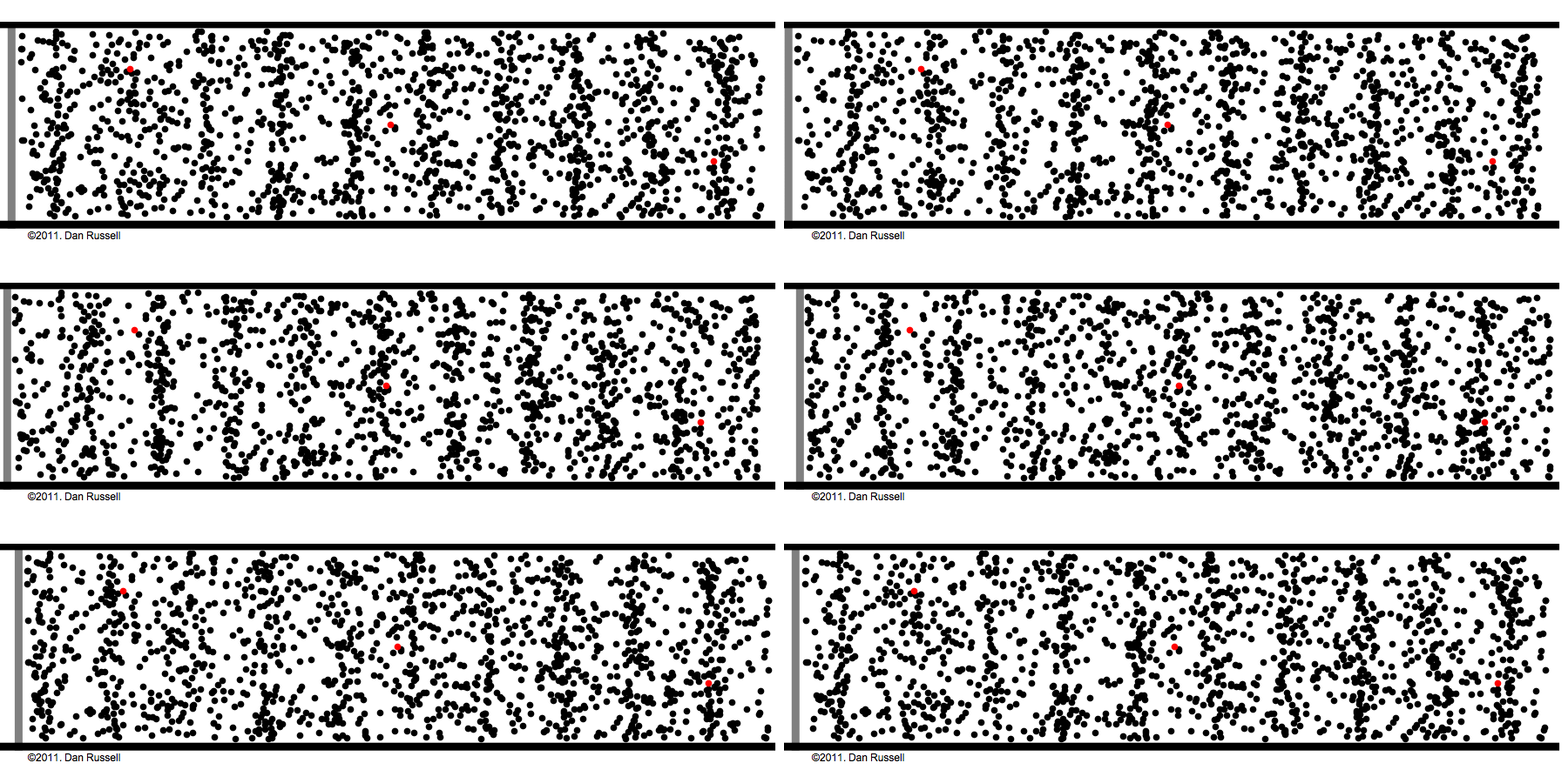
In a similar fashion the recorder, pipe, trombone, trumpet, oboe, bagpipes, etc. set enclosed lengths of air inside them into longitudinal vibration using the outbreath of the player. (scrutinise the back and forth movement of the red dot.)
The pitch of the tone created by a string is determined by 3 factors.
|
Factor |
Low-pitched tones |
High-pitched tones |
Method |
|
Linear weight of string/wire |
Heavier weight |
Lighter weight |
Design |
|
Tension in string/wire |
Slacker |
Tauter |
Tuning |
|
Length from bridge to fret |
Longer |
Shorter |
Playing |
The length of a vibrating string can be altered by the player pressing the string on to a fret or the fingerboard.
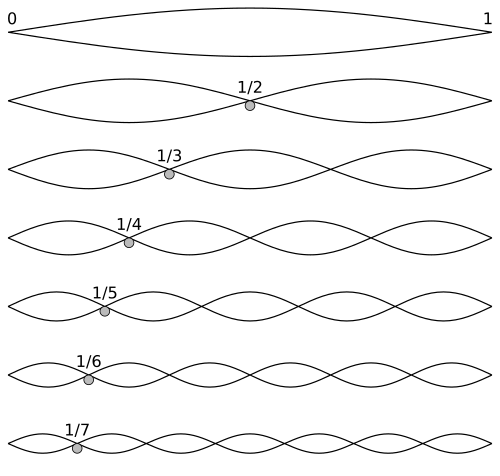
A taut string/wire vibrates only in an exact, whole number of parts. When the part is large/long, then the tone is low.
When it is just a single part, it is called the fundamental tone, tonic or first harmonic.
When the string vibrates in two parts, the tone is called the second harmonic – it vibrates twice as fast as the tonic, that is at double the frequency.
similarly in 3 parts, at triple the frequency.
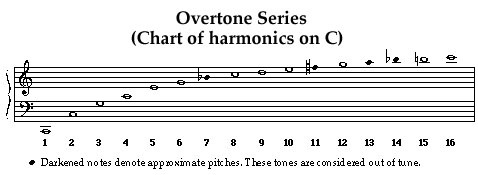
C C G C E G Bb C D E F G A Bb B C
- Resonance: When a guitar string or trumpet pipe vibrates, it resonates strongly at its primary pitch (the fundamental frequency) while simultaneously vibrating in fractional lengths (1/2, 1/3, 1/4) with less intensity.
- Instrument Uniqueness, Timbre: These smaller, hidden frequencies are called overtones, or harmonics. The specific blend and volume of these overtones determine the unique tone quality—or timbre—of every instrument.
- Watch this YouTube demonstration using a C-Horn it enables you to hear the sequence clearly
- Basis of Harmony: The first few overtones of a fundamental note outline the major triad (the fundamental [1st], 3rd, and 5th intervals) naturally. These natural intervals form the basis for most Western musical harmony.
When several tones are played at the same time on different strings they form a “chord”;
When tones are played in a sequence in time, they form a ‘melody’ – the jump from one tone to another is called an “Interval”. - The Fundamental, 2nd, 4th, 8th and 16th harmonics form a very harmonious series: of Diapason (or Octave in modern terminology) interval series with the ratio 1:2. The Octave is the eighth note in a musical major scale.
- The interval between the 2nd and 3rd harmonics is the Diapente (or major Fifth) interval with the ratio 2:3.
- The interval between the 3rd and 4th harmonics is the major Fourth interval with the ratio 3:4.
- The interval between the 4th and 5th harmonics is the major Third interval with the ratio 4:5.
- The interval between the 5th and 6th harmonics is the minor Third interval with the ratio 5:6.
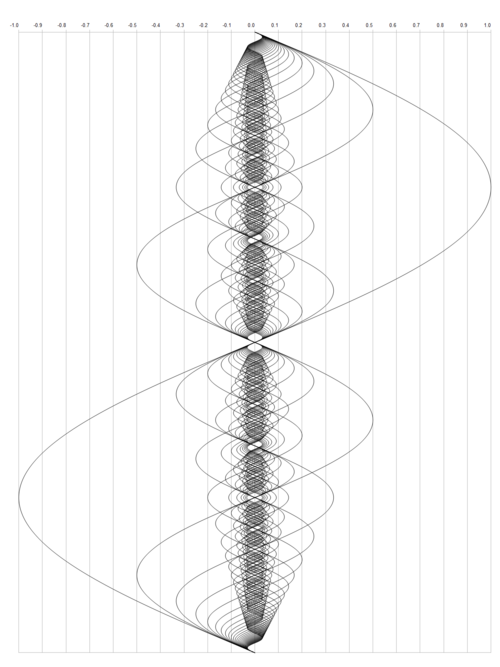
The Nodes are the parts of the string that twist a small angle, but do not move sideways or laterally.
The Antinodes are the parts of the string that move sideways but do not twist.
The form that they make is called a sine wave.
This scale was only replaced in 19th Century by the 12 semi-tone equal-tempered Octave (based on the 12th root of 2). More about this when we consider the power series.
More next week. RB
Posted: 9 Jul 2026