


Anthroposophy in Hawkes Bay
An Easter Song - Dying and Becoming
By Allysen Caris
"We die a little every day,
In countless ways, from cells
In our bodies to old habits -
More difficult to let go.
Each night we die
To the physical world,
To soar in light-filled spaces
To strengthen the next new day.
This long journey of becoming
Is a continual dying and renewing
For the new needs space
To grow, untrammelled by the old.
The caterpillar dies in the chrysalis
And from its sunlit dream
Emerges its new self, butterfly
With wings of spun sunlight.
Autumn leaves in their dying
Blaze in vivid colours before they fall,
So let me blaze brightly now
To become all that I can be.
In this long journey
Let die selfishness and greed
To make way for the greater me,
So – just for a moment – I can say:
“Not I, but Christ in me:
Not I, but Christ in me.”
Easter Sunday -- Resurrection
Rudolf Steiner considered the essence of Easter's resurrection to be the victory of our spirit over materialistic thought -- reawakening the knowledge that the immortal human soul is connected to the cosmos. It represents the "Christ Impulse"—the inner resurrection of a super-sensible awareness of oneself as a spiritual being, rising from the "grave" of materialistic modern life.
Easter is not merely a natural spring festival of renewal, but a cosmic event marking the Spirit’s rise within Western civilization, combating materialistic worldviews.
Rudolf Steiner emphasized St. Paul’s message as the essence of Easter: transforming the materialistic "not I, but the animal in me" into the spiritual awakening of "not I, but Christ in me".
Also, resurrection must not be considered just a past historical event or a distant article of faith, but a living experience of the modern soul, where humanity realizes its own spiritual immortality.
Through the Mystery of Golgotha, Christ linked his resurrection to all of humanity, giving individual human beings the power to experience a resurrection from "death" and find their divine, eternal nature. Resurrection signifies our soul's ability to expand beyond narrow personal existence to live in harmony with the cosmos, realizing the immortal being that descends from spiritual worlds.
========
The date of the Easter celebration is determined by three heavenly events as seen from the Earth:
- Date of the northern vernal (spring) Equinox: 20 March 2026;
- Date of the next full Moon (the Passover or Paschal Moon). This means [for the northern hemisphere] that after winter during which the Moon was dominant/high in the night sky, for the first time in the year the noon Sun {Christ} at midday is higher than the full Moon {Yahweh} at midnight - a form of resurrection: 2 April 2026;
- Date of the next Sunday: 5 April 2026 is Easter Sunday
~~~~~~~~~~~~~~~~~~~~
~~~~~~~~~~~~~~~~~~~~~~~~~~~~~~~~~~~~~~~~~
Rudolf Steiner Centre, 401 Whitehead Road, Hastings
Events in brief
over next 2 weeks: 5 to 19 April 2026
- Saturday 4 April.11:00 am. School of Spiritual Science Lesson 3. (No early discussion)
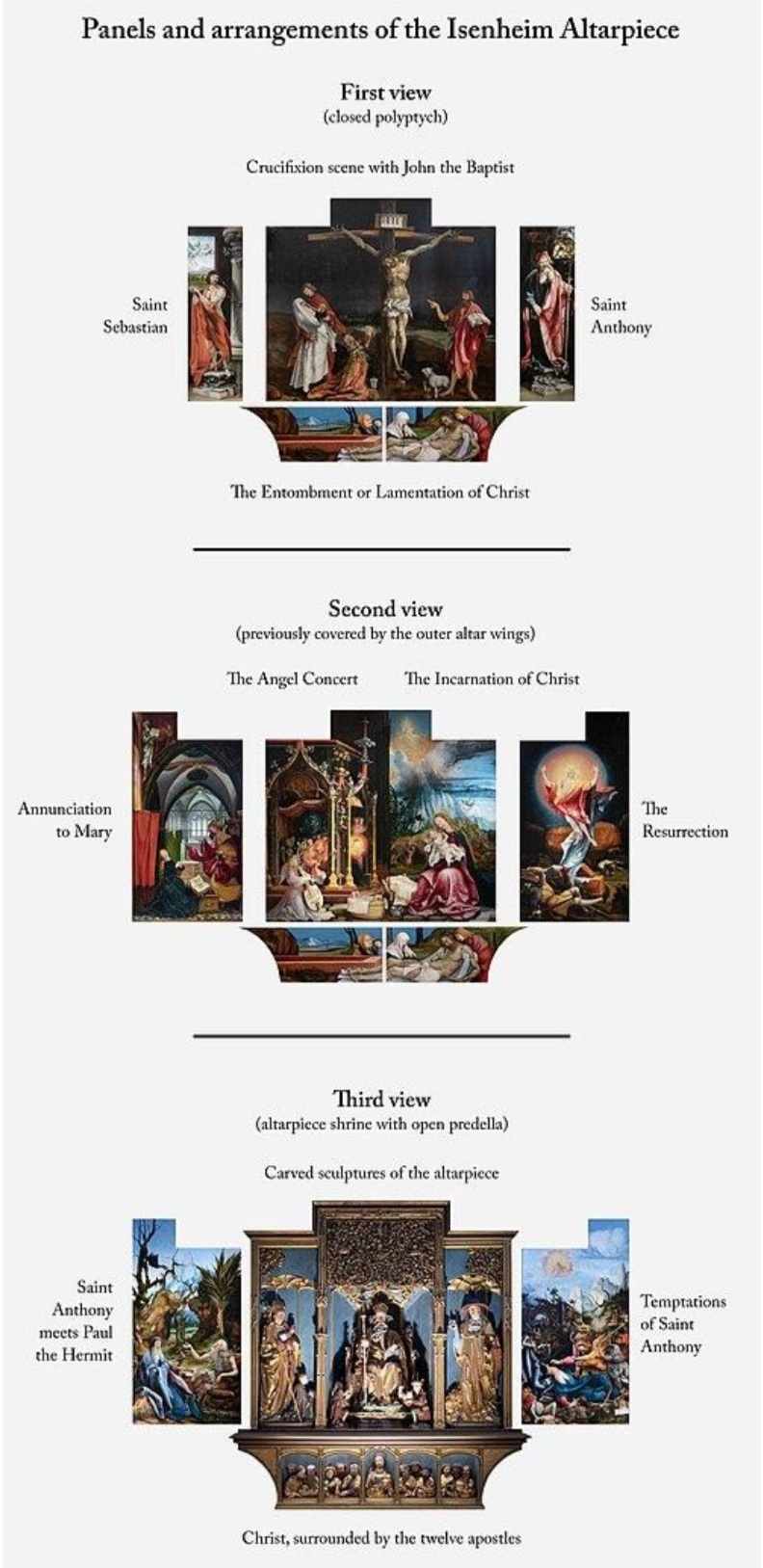
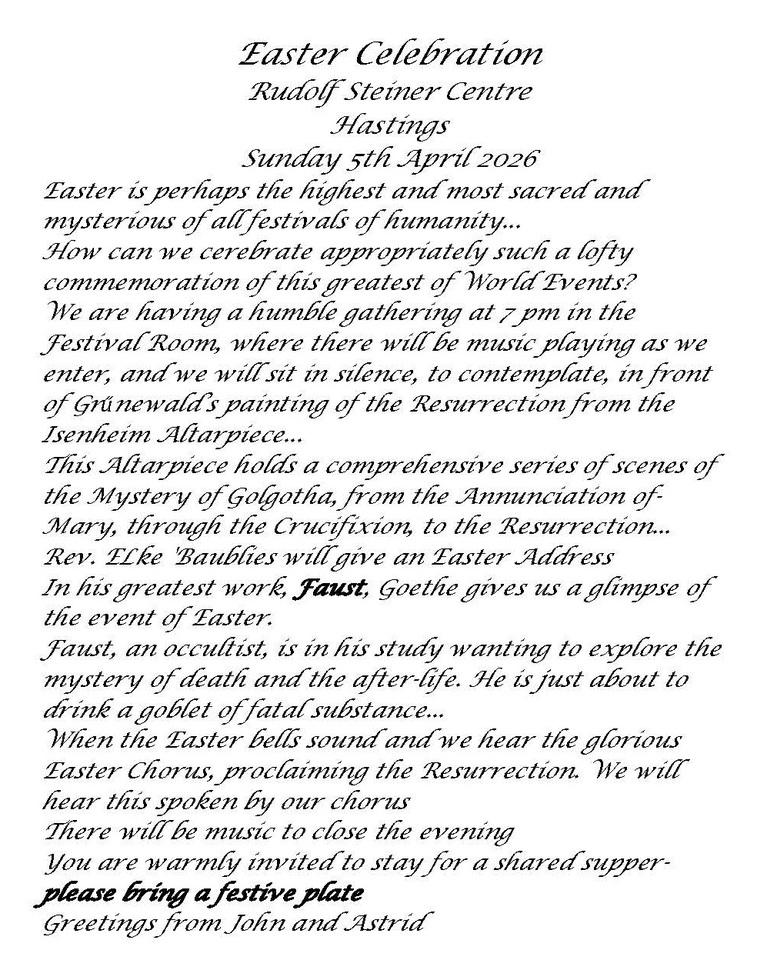
- Sunday 5 April. 7 pm. Easter Celebration
- Friday 10 April. 7 pm. Friday Conversation Group. Focus: "Karmic Relationships" Vol viii, Lect 5, p66.
~~~~~~~~~~~~~~~~~~~~~~~~~~~~~~~~~~~~~~~~~~~~
Later in the year:
- Friday 24 April. 7 pm. An Early English and Chaucer Evening with Tania Diedericks
- Saturday 2 May. 9:30 am. School of Spiritual Science, Lesson 4.
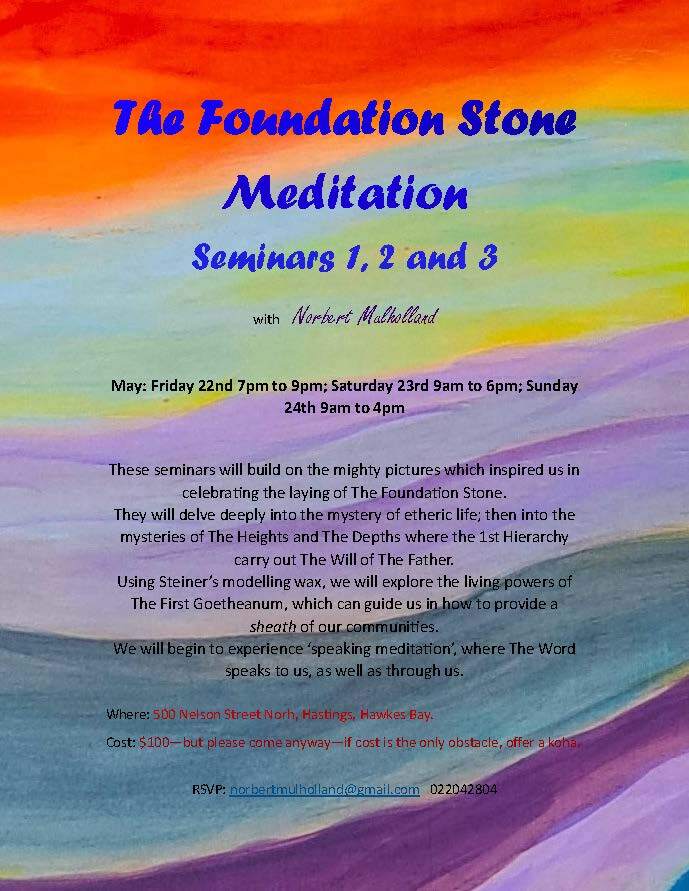
- Friday 22 to Sunday 24 May. Meditation Seminars 1, 2, 3 with Norbert Mulholland**
- Friday 12 June. Talk by Dr. Richard Drexel on "Sleep" **
- Saturday 13 June. ASNZ AGM and Society Day in Hawke's Bay
- Saturday 25 July. Anthroposophy Hawke's Bay AGM.
~~~~~~~~~~~~~~~~~~~~~~~~~
Protecting ourselves
John Allison
As part of my address on Michael past and present at our Autumn Festival, I spoke of the enchantment of the elemental spirits. Rudolf Steiner revealed that when we look passively at the plants and trees and only think of them as so much matter, then the “Dragon” [materialistic] forces working in us, are strengthened and ‘chain’ these beings and also make us ever more heavy and material.
If we become active and look at the plants in a soul-filled way, aware of the active spirit, then we release the elemental beings from the ‘dragon’. Also, we protect ourselves from bacteria and bacilli that the ‘dragon’ creates in us!
The lecture where Steiner speaks of this in the series Michaelmas and the Gemut. GA 223, Lecture 2 .
~~~~~~~~~~~~~~~~~~~~~~~~
Introduction to the First Class of the School of Spiritual Science with David Urieli
A reminder to all those who attend: "we won't be meeting on Wednesday mornings for the next two weeks."
~~~~~~~~~~~~~~~~~~~~~~~~~~~~~~~~~~~~~~~~
An Early English and Chaucer Evening
Tania Diedericks (school parent) is in her final year of a speech and drama training and will perform 3 early English ballads arising from oral tradition; as well as five characters (pilgrims) from "The Canterbury Tales" by Geoffrey Chaucer. There will also be early music and song contributing to a rich evening, celebrating the beginnings of English literature.
I would like to do it on Friday 24th April at 7pm.
~~~~~~~~~~~~~~~~~~~~~~~~~~~~~~~~~~~~~~~~~~~~~~~~~~
Meditation Seminar with Norbert Mulholland
Please register for the 3 seminars in May with Norbert directly with him (see poster for contact details),
Gerrit
For the AHB Committee
RSVP: norbertmulholland@gmail.com 022 042804
Rationale For The Foundation Stone Meditation Seminars
To address ‘the deep longing for redemption in Human Souls’*
To build sheaths for communities dedicated to preparing a new Humanity.
‘So that through human will the earth can reach the goal set her from the very beginning.‘**
Taking up The Foundation Stone Meditation arms us against every adversary.
The granting of this meditation to Humanity is quite possibly the single most important deed of Rudolf Steiner's life. Our work with it will never cease.
Seminar 01: The Macrocosmic Lords Prayer; Christian Rosenkreutz; The House of The Word
Seminar 02: The living Goetheanum, the living ‘sheath’
Seminar 03: The First Tablet—The Father God
Seminar 04: The Second Tablet—The Son God
Seminar 05: The Third Tablet—The Spirit God
Seminar 06: Life Spirit/’Buddhi’: The Elemental Spirits—Humanity
Seminar 07: The New Earth—New Sun
The intuition for this initiative arose in the early days of Covid19, before Klaus Schwab (founder and then Executive Chair of The World Economic Forum) announced a ‘great reset’—calling this reset ‘a turning point’ in human history, the target year for implementation was 2030.
The final Foundation Stone seminar would also fall in 2030.
Bearing in mind that Steiner stated, specifically at the laying of the foundation stone, that the real turning point of time is 33, and counting 3x666 years (1998 the time of Sorat, ‘the sun demon’) after the turning point, we arrive at 2031, when we can expect a mighty adversarial impulse, advancing an exclusively material, technological reality.
Should we be able to complete the above seminars, it would be possible to enact a significant deed in 2031 centred on The Foundation Stone Meditation, which would counter ‘The Beast’*** and advance the true mission of the earth—freedom and love.
* and ** laying of the foundation stone of The First Goetheanum, September 1913
***The Apocalypse of St. John: Revelation 13:18
~~~~~~~~~~~~~~~~~~~~~~~~~~~~~
Study Course
Free anthro-related study course are starting up again. I’m hosting the one on Refined Breathing, Wednesday’s at 8:30pm, so that’s convenient for NZ.
https://mystech.org/study-group-courses/#myst-sc-courses
"MysTech is devoted to cultivating a "mechanical occultism" that supports human evolution in fitting with the divine plan as understood from Anthroposophy. Our study groups meet weekly via Zoom and are open to anyone seeking a deeper understanding of the spiritual forces at work in modern technology.”
Regards,
Herman Veluwenkamp
~~~~~~~~~~~~~~~~~~~~~~~~~
Musings on Arithmetic 2
Last week's Musing 1 as a PowerPoint and some thoughts on Number recognition.
Some more next week.
Robin
Posted: 1 Apr 2026