


Anthroposophy in Hawkes Bay
Rudolf Steiner Centre, 401 Whitehead Road, Hastings
Events in brief for your diary
Friday 26 June to Sunday 12 July 2026
- Friday 26 June, 7 to 8:30 pm. Friday Conversation Group meets in the Library. Study text is Christianity as Mystical Fact* 3rd edition
- Sunday 28 June, 7 pm. Midwinter Festival. Details below
- Saturday 4 July from 9:30 am. School of Spiritual Science. Lesson 6.
- Saturday 4 July from 3 to 4 pm. A consultation meeting about creating a replacement for the Branch's 2008 Constitution as requested by the Charities Commission.
- MONDAYS 6, 13, 20, 27 July 7 pm. Conversations on the Christmas 1923 FOUNDATION STONE**
~~~~~~~~~~~~~~~~~~~~~~~~~~~~~~~~~~~~~~~~~~~~
Later in the year:
- Saturday 25 July. 2 pm. Anthroposophy Hawke's Bay AGM. Approving a new Constitution.
- Saturday 25 July, from 3:30 pm (after AGM) to 5 pm. Talking, Listening, Caring. Invitation
- First Saturday of every month, from 9:30 am. School of Spiritual Science. 4 July; 1 August; 5 September; 3 October; 7 November; 5 December.
~~~~~~~~~~~~~~~~~~~~~~~~
This newsletter is now sent out on Friday mornings to include weekend notices, so please have your articles to me by Wednesday evenings. (robin@bacchus.co.nz).
Apart from local members and friends in Hawkes Bay, modern technology enables it to reach much wider readership in Christchurch, Wellington, Auckland, Northland, and a number overseas. Positive feedback is often received and is very appreciated. Robin
~~~~~~~~~~~~~~~~~~~~~~~~~
Christianity as Mystical Fact (1902) GA8, is a foundational work of Anthroposophy. It bridges the gap between pre-Christian pagan mysteries and the historical Gospels, framing the Christ event as the pivotal turning point in human spiritual evolution. The book is the written elaboration of a series of 24 lectures given by Rudolf Steiner from October 1901 to April 1902 at the Berlin Theosophical Library at the invitation of Cay Lorenz, Count von Brockdorff, and Sophie, Countess von Brockdorff.
The Friday Conversation Group is just starting a study of this book - a wonderful time to join us at 7 pm tonight in the Library 26 June. There are some copies of the text in the Library.
~~~~~~~~~~~~~~~~~~~~~~~~~
Midwinter Festival
Rudolf Steiner Centre
This Sunday, 28th June
ALL WELCOME
3:00 pm Reading: Gabriel Imagination from the Four Seasons and the Archangels by Rudolf Steiner, with John Jackson.
4:30 pm Painting session: for the midwinter, with Sonya Lethbridge.
- There will be soup for those who want to stay afterwards for the evening.
6:30 pm Social gathering over refreshements in the Foyer – please bring a plate to share
7:00 pm Festival Celebration in the Festival Room
Click on link above for more details of the evening's items.
It used to be in Autumn time that the Easter Festival was held, Rudolf Steiner tells us. It is when we can see the resurrection forces in the autumn colours of nature. Michael – who is like God – gives us the courage to recognise the counter forces in us : we ‘fight against the dragon’ and gain a new consciousness that allows the inner light to shine in the Midwinter.
We can now come to be at peace inwardly: Gabriel – who is God’s Strength - helps us to come to ourselves in a new way, after the storm and commotion in nature. The Earth and the elemental world are at peace, and the Christ light can shine inside each human being.
This inner light rays out and can create new social warmth and love.
In our festival this year we will recite St Paul’s Corithians 13 again, which Rudolf Steiner translated for us to learn from, showing how love in its deepest significance can become the essence in all we do, feel, think and speak.
After John Jackson’s welcome, Robyn Hewetson will speak a winter poem;
Matthew Frear will lead us in singing the Holy Night Round of Julian’s 52 Souls Calendar Rounds, together.
The chorus will speak Corinthians 13,
Johnny Ryan will take us on an inner journey in his festival address.
We will sing the round again together
The chorus will present Soloviev’s Immanuel – God with us, showing how the all-powerful divine is always with us, helping us to realise that we are co-responsible for the future evolution of humanity, if we can step into that inner strength.
.......................................
In the midwinter it is very special to do painting – experiencing form and espcially also colour – something in our soul gets tuned when we live into colour. It is relaxing and gives us pleasure and a hightened awareness, above all, it has a healing effect on the soul.
Here is a sample of a picture that Sonya Lethbridge likes to work on. She speaks about biological painting.
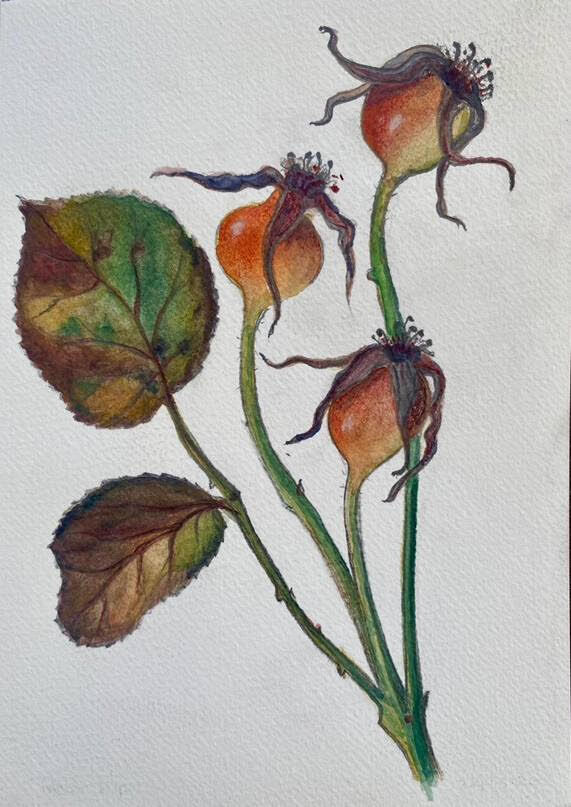
Sonya is a student of Margaret-Mary’s Art Therapy Training.
You will get to know her through the work on a Midwinter theme, which we will be doing with her on Sunday, 28th June – at our Midwinter Festival, at 4:30 pm. All welcome. No prior experience required.
The evening festival address will be given by Johnny Ryan.
Johnny is a retired Lower School teacher who enjoys sharing his experiences with other teachers of all kinds at Taruna. These are bright but brief punctuations in a busy life normally spent with his family on a wee farm or renting transportable cabins to customers in the Hastings area as a way of income. While not glamorous, this is a great way to ‘make more space available’ – not just for customers but for Johnny. With that benefit of time, he enters every day as diligently as possible through the varied and precise suggestions of Rudolf Steiner. He then generally fails to live up to those expectations for the rest of the day. He is, however, always happy to discuss these trials of life with anyone else prepared to talk or listen.
 Photo of Johnny and wife Phillipa
The mid-Winter Talk for 2026
Crystaline thoughts and The Rainbow Crow
Johnny will explore a view of the Mineral World and retell a winter story of community and sacrifice from the Native American Siuox.
Festival preparation: Astrid and John.
~~~~~~~~~~~~~~~~~~~~~~~~~~~~~~~~~~~~
Our Society’s Constitution.
Forming a society provides a formal legal structure for a community group, which plans to operate socially over a long term.
The main reasons to form a society include:
- Legal Protection: It creates a distinct legal identity. This means individual members and committee officers are generally not personally liable for the society's debts, contracts, or financial obligations.
- Asset Security: Any property ( the Anthroposophical Centre), funds, library or equipment belong to the society as a whole, not to any single individual.
- Independent Existence (Continuity): The organization continues to operate smoothly even if members, volunteers, or committee leaders change over time.
- Financial and Operational Freedom: As a standalone entity, the society can easily open its own bank account, hold leases, hire staff, apply for funding grants, and enter into contracts.
- Credibility: It builds trust with funding agencies, donors, and the broader community by demonstrating structured, transparent governance.
For us here in Hawke's Bay, the Anthroposophical Society is threefold:
Global: General Anthroposophical Society (GAS) [Allgemeine Anthroposophische Gesellschaft] is based at the Goetheanum, Dornach, Switzerland and is run by a Vorstand.
Country or national: Anthroposophical Society of New Zealand (ASNZ) run by a Council with a Representative who regularly visits centres around NZ and also attends meetings at the Goetheanum on our behalf.
Local: Anthroposophy Hawke's Bay (AHB) owns the Centre at 401 Whitehead Road and is run by a Committee (responsible for maintaining its assets to a good standard for use by members) and Trustees.
There are two legal forms for Societies in New Zealand: Incorporated and Charitable. Our society was originally formed in 1990 as a Charitable Trust, which it still is. We report annually to the recently reformed Charities Commission, which has an overseeing role that is carried out by Charities Services (Ngā Ratonga Kaupapa Atawhai), a business unit within the Department of Internal Affairs. Its primary function is to regulate the charitable sector and promote public trust and confidence through transparency and accountability.
The Commission has asked all charitable organisations to review their Rules or Constitution to ensure that they are fit for purpose. The ASNZ has totally rewritten its Constitution, which was adopted, after regional consultation meetings, on 13 June.
It is now time for us, AHB, to improve our local constitution, which was written in 2008. Our AGM is scheduled for Saturday 25 July, about 5 weeks away. Revising the Constitution is on the Agenda.
As this process is complex, the Committee will have a Consultation Meeting on Saturday 4 July from 3 pm to 4:30 pm at the Centre.
Some of the issues are:
- How membership is determined and managed;
- How financial support is handled;
- The roles and responsibilities of Trustees and Committee members.
The aim is to reform the current Constitution into a form that can be simply adopted as a whole (as was done by the ASNZ) at our AGM. You can read Proposals for change so far along with a commentary on them.
We call on all those who have an interest in these matters to join us on Saturday 4 July at 3pm.
~~~~~~~~~~~~~~~~~~~~~~
Conversations on the Christmas Foundation of 1923
For the four MONDAYS 6th, 13th, 20th and 27th in July there will be a
conversation on the FOUNDATION STONE at the centre.
Conversations from 7 pm
The Foundation Stone as laid at the Christmas Conference 1923-24 is
such a fundamental event in the life of Anthroposophy that it is not easy to
comprehend all its ramifications. I would like to consider one aspect:
what it cost RUDOLF STEINER to take on his shoulders, the destiny of
the Anthroposophical Society.
Christopher Bacchus
~~~~~~~~~~~~~~~~~~~~~~~~~~~~~
Arithmetic Musings #13
Odds and Evens
Over the next few weeks, I would like to look at the simple idea of odds and evens that fascinated the famous Greek philosopher Pythagoras (570 to 495 BC), who related them to 'space' and 'time'.
The name Pythagoras originates from Pythios (a name for the god Apollo) and agora (meaning "marketplace" or "assembly"). Together, the name translates roughly to "spoken by the Pythian [Apollo]" or "oracle of the marketplace," honouring the god Apollo, associated with wisdom and prophecy.
Apollo and Dionysus are complementary half-brothers in Greek mythology.
Apollo, god of the sun, prophecy, and music, represents structure, self-control, the conscious mind, reason, logic, and harmony;
Dionysus, god of theatre, wine, ritual madness (as the lack of conformity of the newly developing EGO was perceived). He represents raw emotion, instinct, and the unconscious mind, embodying passion, ecstasy, and chaos.
Rather than rivals, the ancient Greeks viewed them as essential counterparts whose energies balanced one another, particularly in the arts and at the oracle of Delphi.
First, let us look at ODD numbers.
1 1 1+0
3 1 + 1 + 1 1+2
5 2 + 1 + 2 1+4
7 3 + 1 + 3 1+6
9 4 + 1 + 4 1+8
and so on.
In the diagram below, first lay pebbles in a straight line with the 'unpaired one' in the middle.
Next bend the line (with the unpaired one in the middle) at right-angles, so they form a series of squares.
A line has length, but a square has area.
One of the great geometrical insights of Pythagoras was about right-angled triangles.
Triangles, as the name indicates, have 3 angles between adjacent sides; but they have 3 points (or vertices) and 3 lines (or sides). 3x3 = 32 = 9.
Angles can be measured as a portion of a full turn. A turn can be divided into much finer portions: 360° [degrees].
The 360° came from Astronomy when the year was seen as the return of the sun to the same place in the zodiac in just over 360 days. Actually 365.24 days - that is 360 days with an extra 5.24 days. In ancient Mesopotamia [the flat land between the River Tigris and the River Euphrates, capital Babylon] they had a Administrative Year of 12 months of 30 days, so each time a new year started, the start moved in relation to the Solar year and the agricultural seasons! The next year would thus start about 5 days earlier. This mounted up so that after a 70 year cycle it would a full year early! 70 [3 score years and ten] was considered the length of a human lifetime - how fitting!
In due course the calendar became close to a solar year of 12 months of 30 days (= 360 days) by adding a 5 day pause before the next year began. [another small problem: the time from one full moon to the next is only 29.5 days, not 30!! So 12 moonths made a Lunar year of 354 days) The 5 days added to the end of the Admin year, before the Solar new year could begin, were used to create a Holy New Year festival. So they came to be known as Holidays. As you can see 360 is nearly midway between the lunar 354 days and the solar 365.24 days - a good compromise.
Later, this arrangement was changed and the holidays were distributed through the year, so the odd-numbered months January, March, May, July*, etc. got an extra day (holiday), making that month 31 in total. To do this properly they needed 6 days but only had 5, so 1 day was taken from February so it had only 29! Perhaps they were just trying to make winter shorter? What we can notice is: 'Nothing fits mechanically!' Our solar system is not a machine!
(* July and August are named by Julius Caesar and Augustus Caesar. The high summer month of August, being the 8th [not an odd number] month, only had 30 days until Caesar decreed that it also would have 31, thus altering the sequence for the following months - now both October and December getting 31 days - so another day had to be 'stolen' from February.)
Anyway, based on this, we still use 360° for a full turn, so 180° for a half turn, and 90° for a quarter turn - the corner of a regular square, and 60° for the corner of a regular triangle, a 1/6th turn.
So what was it that Pythagoras noticed?
That all 3 internal angles of every triangle always summed to 180°, the same as only 2 angles (or half) of a square.
That is: if one angle of a triangle was a right angle (90°) then the other two angles together must have the same value of 90°.
Now the remarkable discovery was that at the same time if squares were constructed on the sides of this triangle, then the area of the square on the longest side (called the hypotenuse) – opposite the right-angle in the triangle – was equal to the areas of the smaller 2 squares combined.
The Right-angle (90°) is the threshold or borderline between Acute (sharp) [between 0° and 90°] and Obtuse (thick) [between 90° and 180°] .
In geometrical diagrams it is a custom to label points or vertices using capital letters A, B, C; and to label lines or sides using small letters a, b, c. In a triangle point A is opposite line a. We can refer to the internal angle at A as ⦞A.
<=> means "less than; equal to; or greater than".
So, the situation in a triangle as noted above can be expressed as:
IF, and only IF, angle ⦞A <=> ⦞B + ⦞C (= 90°), THEN area a2 <=> b2 + c2.
The most famous example (shown) involves the sequence of three whole numbers or Integers, 3, 4, and 5.
52 = 42 + 32. [that is: 25 = 16 + 9]
{This relationship between angles and area is true even if the numbers for the length of the sides are rational or even irrational.}
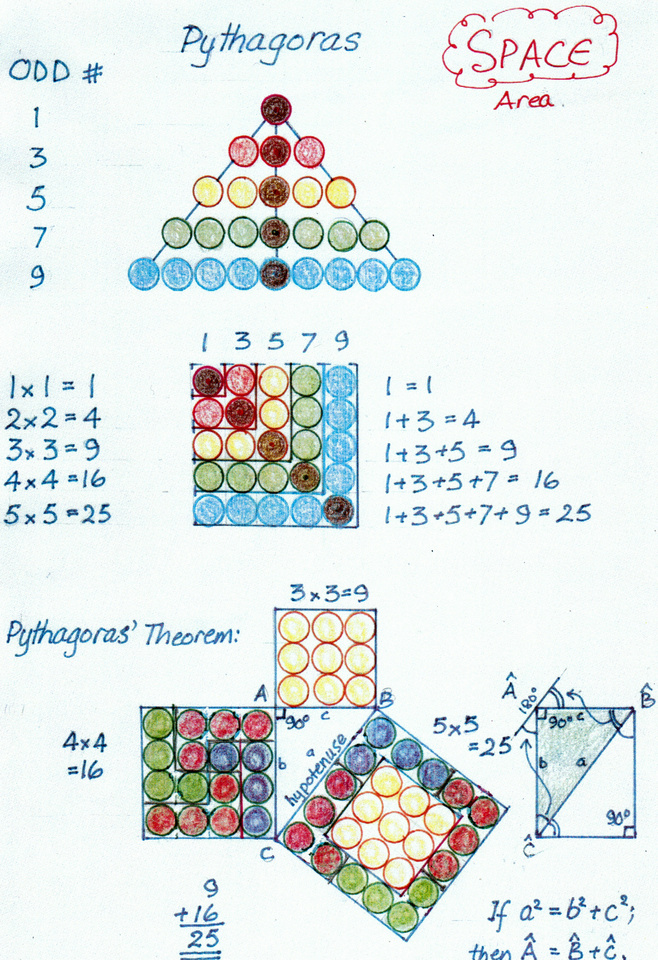
More next week - we will look at further examples of Pythagoras' Triangle Theorem; then the following week at Even numbers and time - in particular musical harmonic frequencies. RB
Posted: 25 Jun 2026