


Anthroposophy in Hawkes Bay
Rudolf Steiner Centre, 401 Whitehead Road, Hastings
Events in brief
over next 2 weeks: 10 to 24 May 2026
- Friday 15 May. 7 pm. Friday Conversation Group. Focus: "Karmic Relationships" Vol viii, Lect 6.
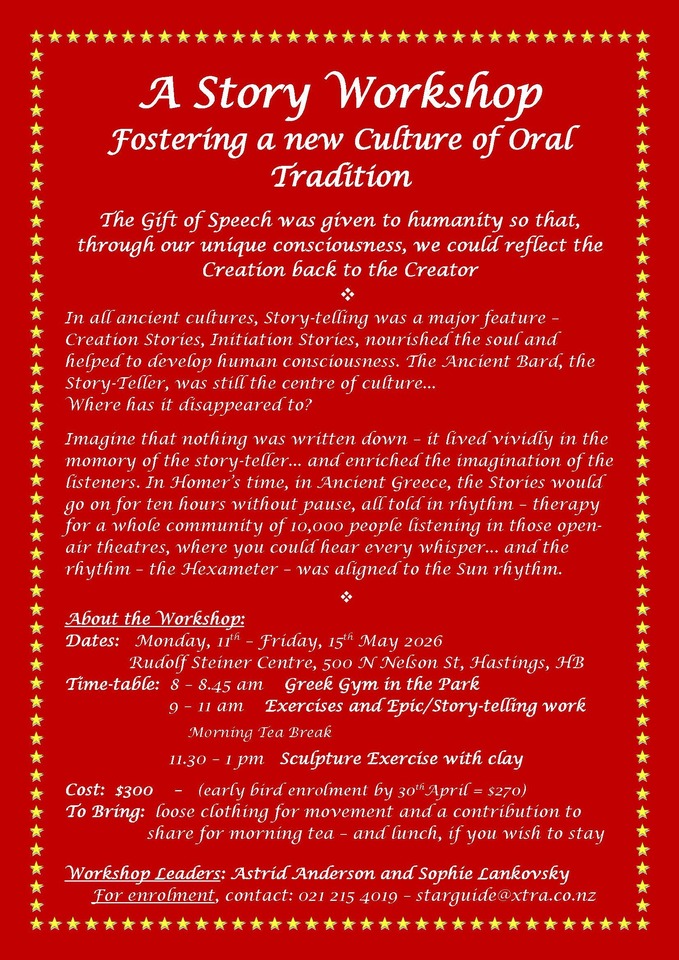
- Monday 11 to Friday 15 May. A Story Workshop
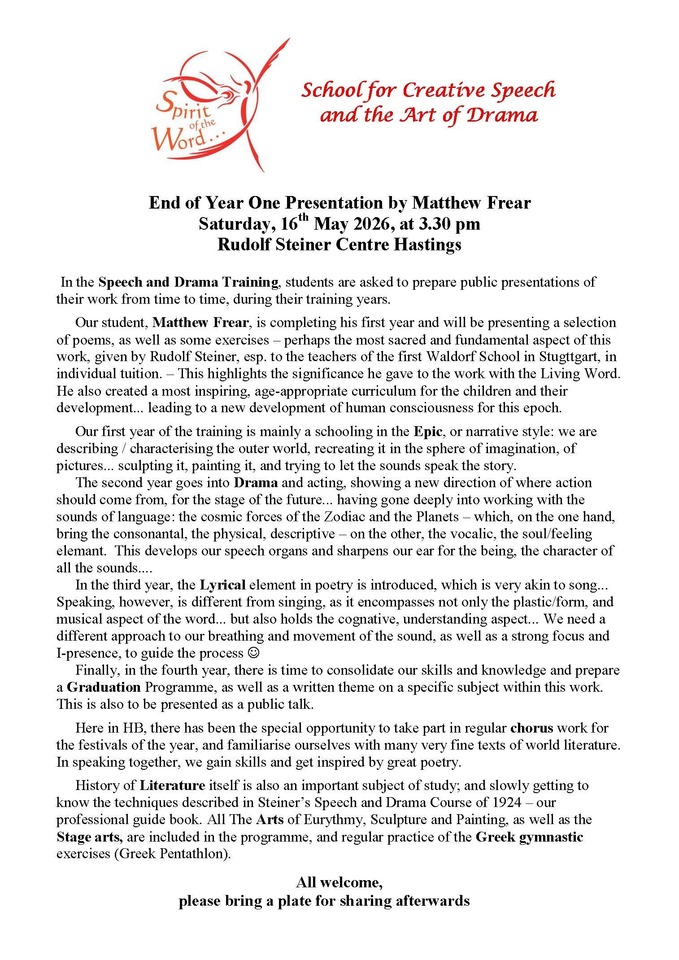
- Saturday 16 May 3:30 pm. Matthew Frear's Presentation**
- Friday 22 to Sunday 24 May. Foundation Stone Meditation Seminars (details on poster) with Norbert Mulholland. Option: to attend only the Friday and Saturday evening lectures for $50 (both)
~~~~~~~~~~~~~~~~~~~~~~~~~~~~~~~~~~~~~~~~~~~~
Later in the year:
- Sunday 31 May. Evening to Commemorate the Dead.
- Friday 12 June. Talk by Dr. Richard Drexel on "Sleep" at Taruna College.
- Saturday 13 June. ASNZ AGM and Society Day in Hawke's Bay
- Sunday 28 June, Midwinter Festival.
- Saturday 25 July. Anthroposophy Hawke's Bay AGM.
~~~~~~~~~~~~~~~~~~~~~~~~~
What the Plant teaches us
For everything we find in man, we can find something analogous in the rest of the world. Schiller has a verse which indicates how, in the realms of Nature, something symbolic of an outstanding human quality can be found:
Seek you the highest, the greatest?
The plant can teach it to you.
What the plant does without willing it,
Go, you and do by willing it.
Schiller here brings before us the being of the plant and urges man to develop in his own character something as noble as the plant is on its own level. And the great German mystic, Angelus Silesius, says much the same:
Not asking why or wherefore blooms the rose
Cares not for herself or whether men behold her.
Here again, we are called to look at the plant world. The plant draws in whatever it needs for growth; it asks no why or wherefore; it flowers because it flowers and cares not whom it may concern. And yet, it is by drawing its life-forces and everything it needs for itself from its environment that the plant acquires whatever worth it can have for its environment and finally for men. Indeed, it attains the highest degree of usefulness that can be imagined for a created being, if it belongs to those realms of the plant world which can be of service to higher beings. And it will now be an idle triviality to repeat here a familiar saying, although it has been quoted so often:
When herself the rose adorns,
She adorns the garden.
When the rose is as beautiful as it can be, the garden is adorned. We can connect this with the word 'egoism', and say: When the rose strives quite egoistically to be as beautiful as she can, and to grace herself with the finest possible form, then through her the garden becomes as beautiful as possible.
Source: Rudolf Steiner – GA 58 – Metamorphoses of the Soul I – VII. Human Egoism – 25 November 1909, Berlin
https://rsarchive.org/Lectures/GA058/English/RSP1983/19091125p01.html
Charming Little Rose Garden by Tina LeCour

~~~~~~~~~~~~~~~~~~~~~
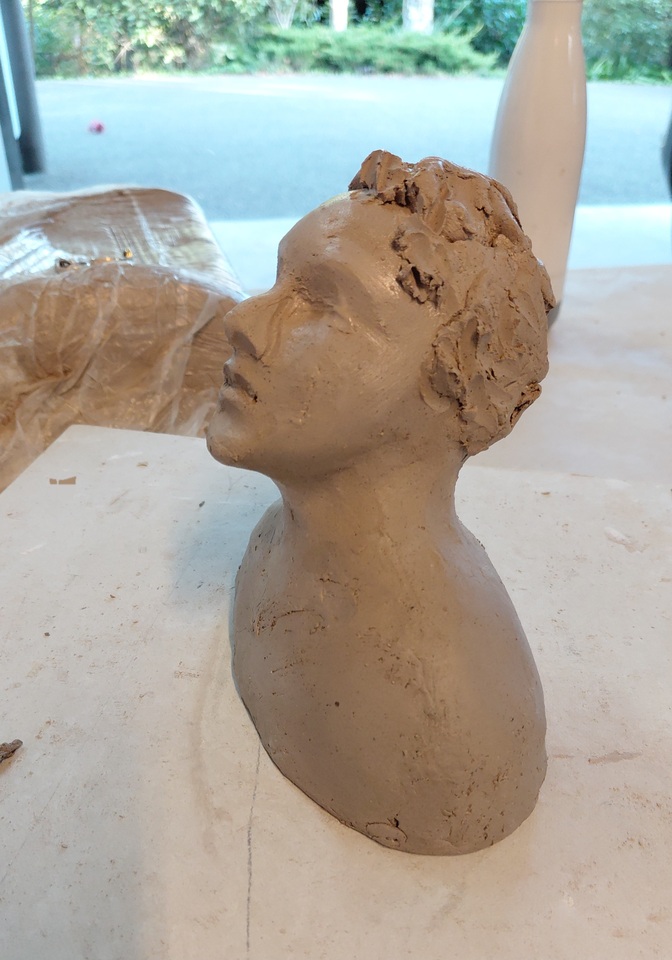
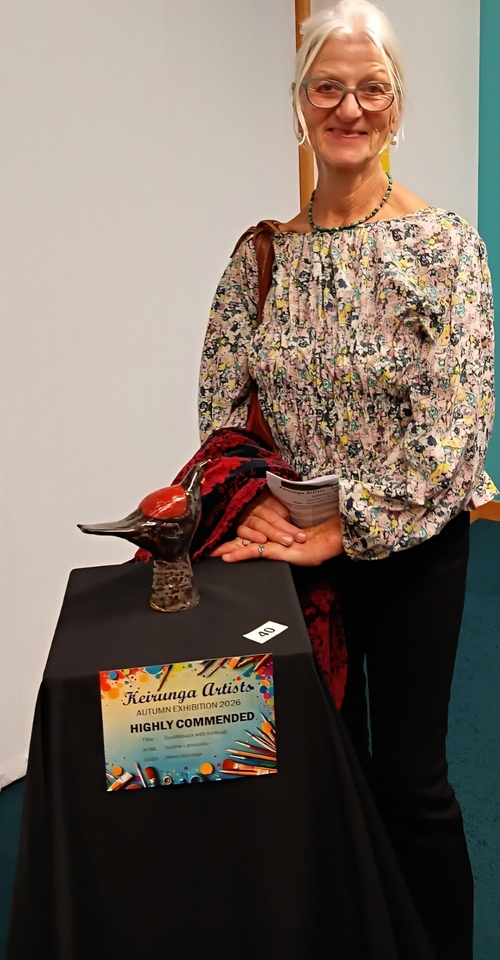
Arts Tutor will be Sophie Lankovsky:
"Sophie fell in love with clay for sculpting as a teenager while attending a Steiner School in Southern Germany.
Its rawness, malleability, and endless possibility of form have inspired a long career in pottery and sculpture.
Clay is both tactile and visual. We will attempt the challenge of metamorphosis of form, from simple to more complex geometric forms. All materials provided."
~~~~~~~~~~~~~~~~~~~~~~~~~
Musings on Arithmetic 7
Click on the link for last week's musings.
This week's theme:
Negativity
There have been several ways of indicating negative numbers.
Thus 72 ̅ = 68 (i.e. 70 – 2)
Because the word processor used to create this newsletter cannot create 'bar' numbers properly but puts the bar after the number [as seen above] not over the top like a hat as required, I have placed the content of this week's Musing in a .pdf of a PowerPoint where they appear properly.
Even with MSWord creating a bar number is quite a long process -- try it to create "bar 5":
- Click 'Insert';
- Click 'Equation';
- Click 'Accent';
- Find the 10th option, called 'Bar';
- Click 'Bar';
- Click in box under the bar that appears;
- type 5.
Some more next week.
Robin
Posted: 6 May 2026